
Best Online Fashion Photo Editing Services for E-Commerce: A Complete Buyer’s Guide
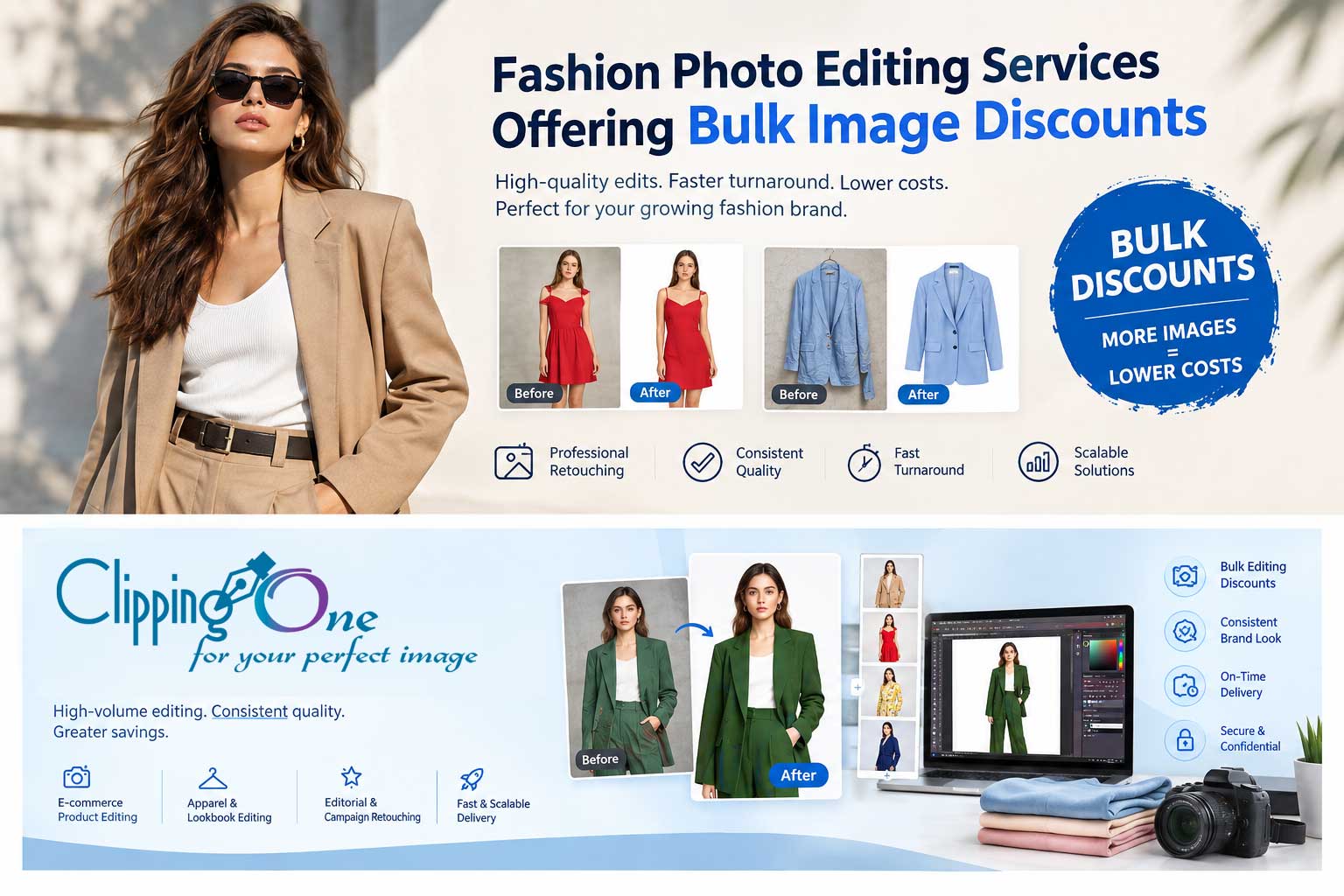
The best online fashion photo editing services for e-commerce can make a difference. Professional editing teams help clothing brands, fashion retailers, photographers, and online stores transform raw photographs into polished, consistent, marketplace-ready product images.
In the competitive world of online fashion retail, product images do much more than show customers what a garment looks like. They communicate quality, establish brand identity, help shoppers understand fabric and fit, and influence whether a visitor feels confident enough to place an order.
However, creating professional fashion images involves more than taking good photographs. Wrinkles, uneven lighting, distracting backgrounds, inconsistent colors, and minor imperfections can make even beautiful clothing look less appealing online. For fashion brands managing hundreds or thousands of product images, editing every photograph individually can also consume valuable time and resources.
From clothing photo retouching and background removal to ghost mannequin editing, color correction, and bulk image processing, the right service can help your business maintain visual consistency while preparing product catalogs more efficiently.
This comprehensive buyer’s guide explains what to look for when comparing online fashion photo editing providers, which services your store may need, how pricing and turnaround times work, and how to evaluate editing quality before committing to a long-term partnership.
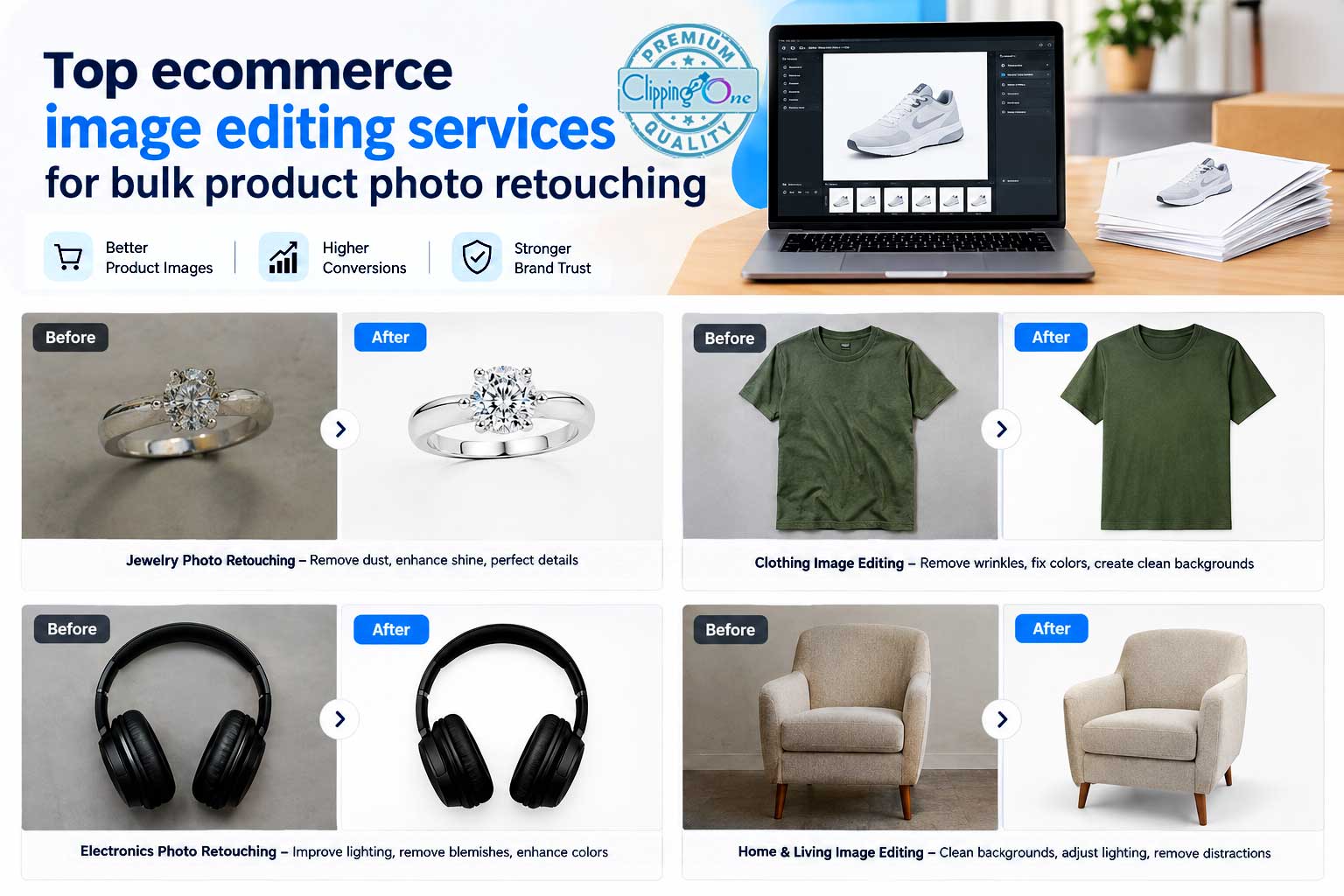
If your business needs reliable support for large product catalogs, explore Clipping Path One’s e-commerce image editing services to learn how professional image post-production can fit into your product photography workflow.
What Are the Best Online Fashion Photo Editing Services for E-Commerce?
The best online fashion photo editing service is one that consistently delivers realistic, brand-aligned, high-resolution product images at a price and turnaround time that fit your business.
Look for a provider that offers:
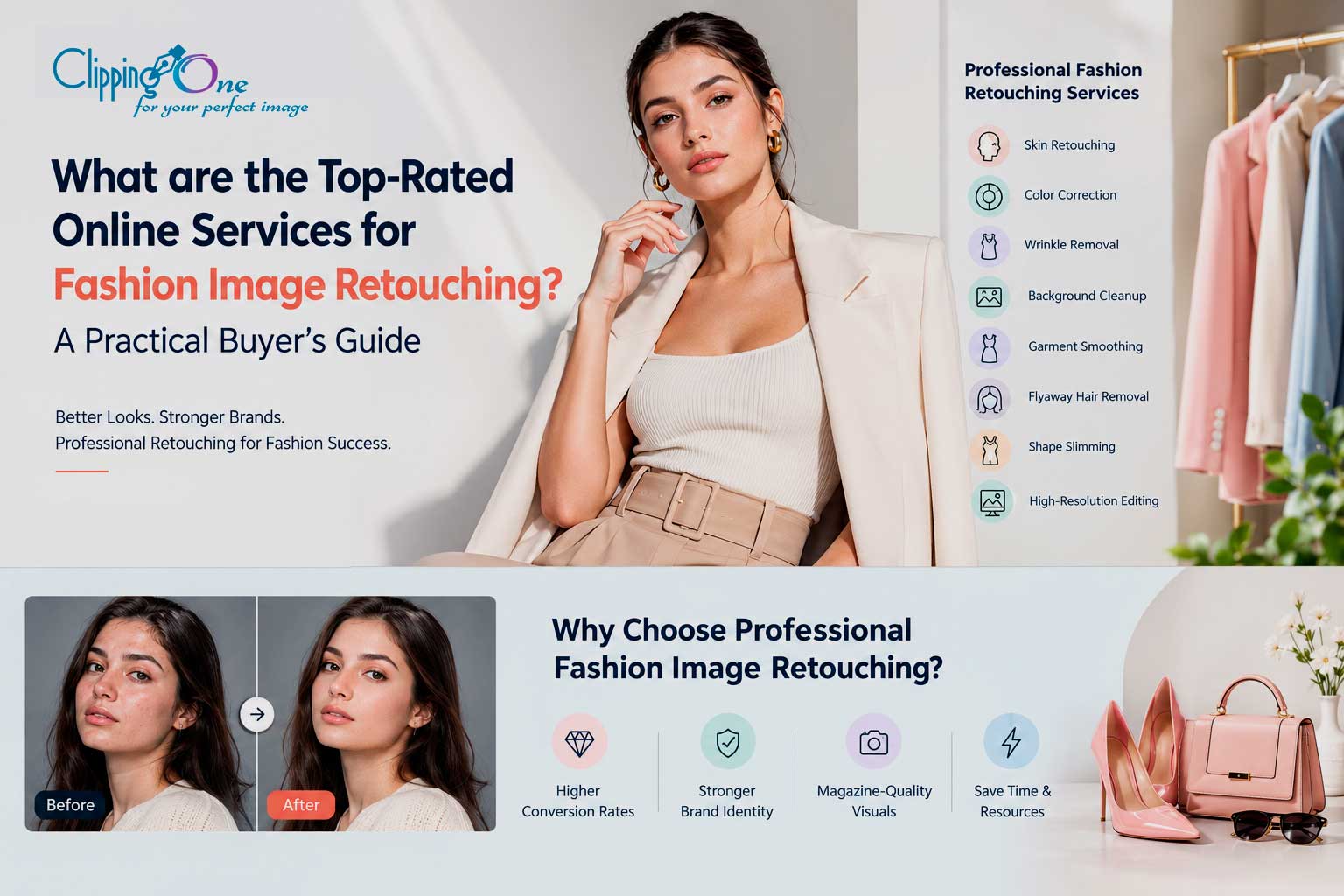
Professional apparel and model retouching.
Accurate clothing color correction and fabric detail preservation.
Background removal, cleanup, and shadow creation.
Ghost mannequin and flat-lay image editing.
Bulk image processing for large fashion catalogs.
Consistent results across product categories and editing batches.
Clear pricing, dependable delivery schedules, and reasonable revision policies.
Secure file handling and commercially appropriate image usage terms.
Free sample edits or a small paid trial before a large commitment.
For smaller stores, a simple pay-per-image service may be sufficient. Growing fashion brands often benefit from dedicated editing teams, while high-volume retailers may need scheduled batch processing, defined quality-control procedures, and workflow integration.
The best choice is not necessarily the cheapest provider or the one that promises the fastest delivery. It is the provider that balances editing quality, realistic product representation, operational reliability, and total cost.
Why Professional Fashion Photo Editing Matters for E-Commerce Success
Fashion is a visual industry. Unlike customers shopping in physical stores, online shoppers cannot touch fabric, examine stitching in person, or try on clothing before purchasing. They rely on product photographs to understand the appearance, texture, color, shape, and overall quality of an item.
High-quality fashion image editing helps bridge this gap between the physical product and the online shopping experience.
First impressions influence purchasing decisions
When shoppers visit a clothing store online, product images are among the first things they notice. Inconsistent lighting, distracting backgrounds, visible wrinkles, and poorly cropped garments can make a professional brand appear less trustworthy.
Professional fashion image retouching helps create clean, attractive photographs that make products easier to evaluate. Consistent images also make category pages, collection pages, and product galleries look more organized.
Accurate images help set realistic expectations
Fashion photo editing should improve presentation without misrepresenting the garment. Overcorrected colors, altered fabric textures, exaggerated body shapes, or digitally removed product features can create a misleading impression.
For example, if a navy-blue dress appears bright royal blue in the product photograph, shoppers may receive something different from what they expected. Accurate color correction and natural retouching help reduce this disconnect.
Consistent photography strengthens brand identity
Imagine browsing a clothing website where every product has different lighting, background tones, image dimensions, and visual styling. Even if the clothes are attractive, the storefront may feel disorganized.
A consistent editing style creates a more cohesive shopping experience. Whether you sell luxury dresses, everyday basics, streetwear, sportswear, or accessories, unified product imagery helps customers recognize your brand.
Professional editing supports catalog growth
A growing fashion store may launch hundreds of new SKUs during seasonal collections, promotions, and product launches. Editing every photograph internally can become a bottleneck.
Outsourced fashion photo retouching enables businesses to distribute editing workloads, establish repeatable workflows, and prepare large image batches without expanding their internal editing team for every seasonal peak.
The key is to treat image editing as an important part of e-commerce operations rather than a last-minute finishing task.
Key Features to Look for in the Best Online Fashion Photo Editing Services
Not every photo editing company specializes in fashion. Some providers primarily handle real estate photography, while others focus on clipping paths, jewelry retouching, or general product images.
Before selecting a provider, check whether its services match the actual needs of your clothing catalog.
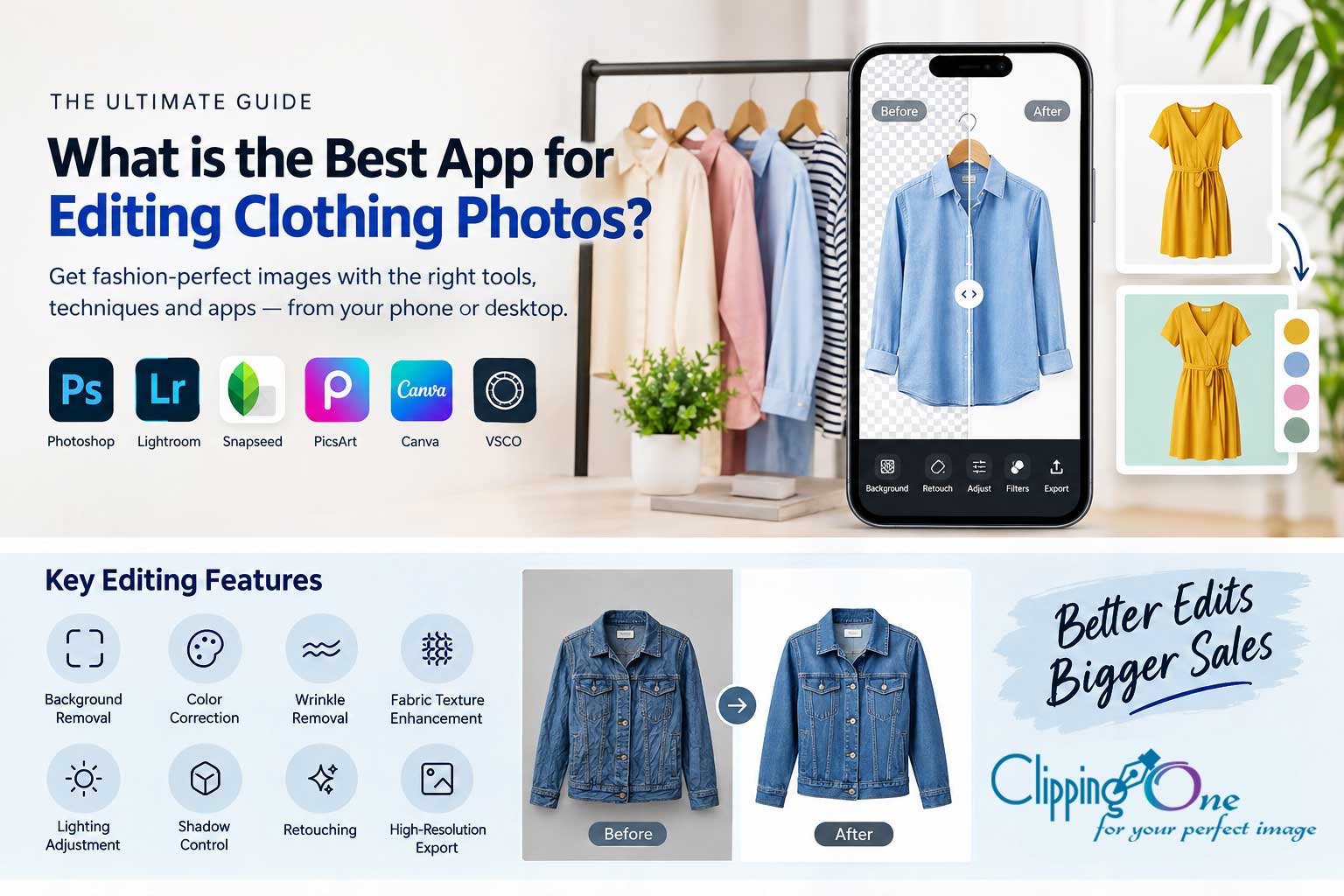
Clothing photo retouching
Clothing retouching improves the presentation of garments while preserving their original construction and characteristics.
Typical tasks include:
Removing distracting creases and unwanted fabric folds.
Cleaning lint, dust, and small surface marks.
Refining garment edges and seams.
Improving exposure and contrast.
Removing temporary distractions from the background.
Preserving stitching, buttons, zippers, embroidery, and fabric texture.
The goal is to make apparel look professionally photographed without making the material appear artificial.
Model and skin retouching
Model retouching is particularly useful for fashion brands using on-model product photography, campaign images, and lookbooks.
Common adjustments include subtle skin cleanup, temporary blemish removal, stray hair correction, and balanced exposure. Depending on the brief, an editor may also refine clothing edges, reduce distracting shadows, and improve overall tonal balance.
Professional retouching should preserve natural skin texture, realistic body proportions, and the model’s recognizable appearance. Excessive smoothing can undermine trust and make the clothing look less realistic.
Accurate color correction
Color correction is essential when customers need to distinguish between similar shades of clothing.
A reliable editor should work from reference images, calibrated workflows where available, and clear brand instructions. The objective is to maintain consistency across a collection while keeping the garment’s color as close to the photographed product as possible.
Color accuracy is especially important for:
Color variants of the same garment.
Coordinated clothing collections.
Denim and neutral basics.
Luxury fabrics with subtle tonal differences.
Multi-channel product catalogs.
Remember that the camera, lighting conditions, monitor, and customer display can all affect perceived color. Editing can improve consistency, but it cannot guarantee identical color appearance on every screen.
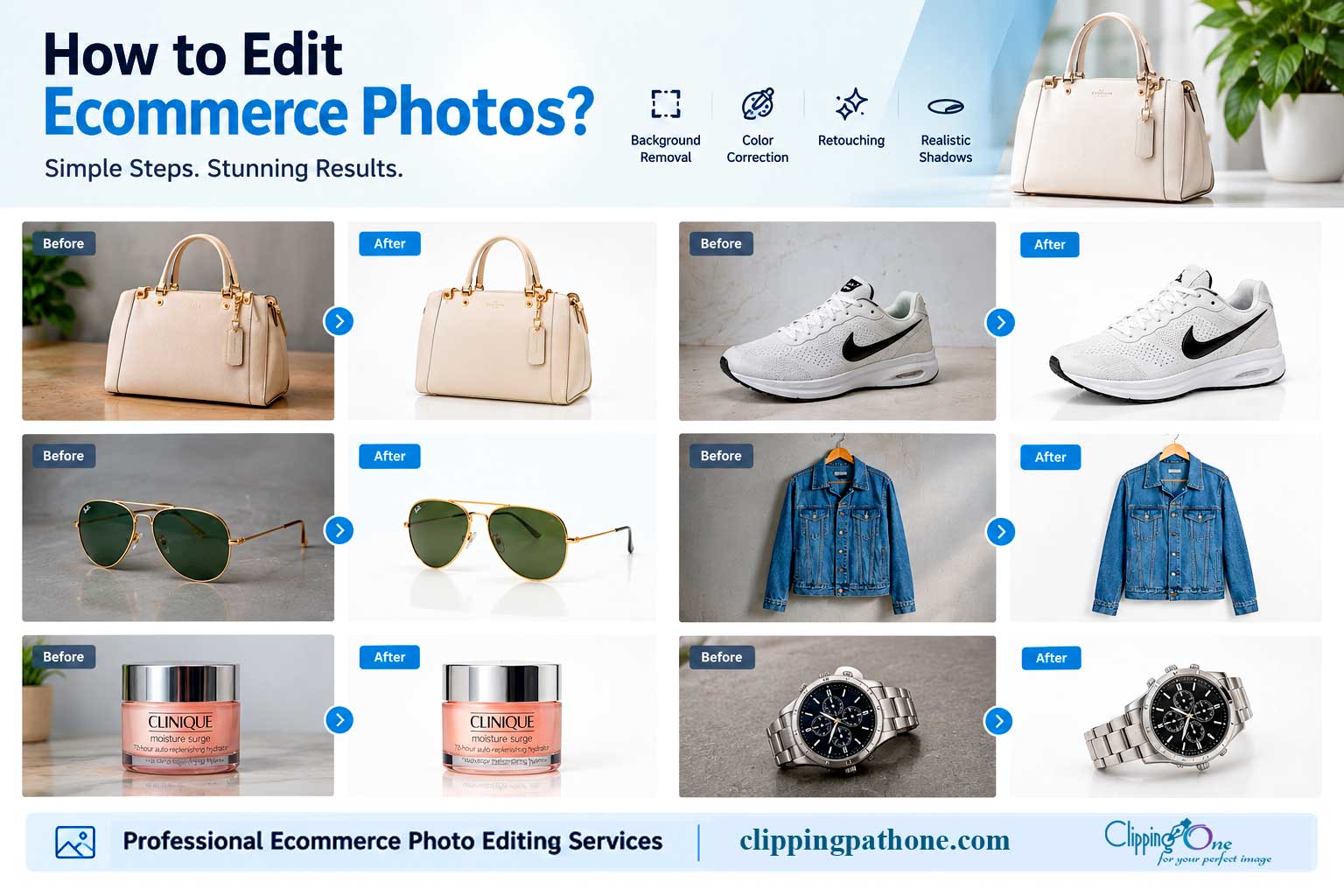
Background removal and cleanup
Background removal separates a garment or model from a distracting environment. The background can then be replaced with white, light gray, transparent pixels, or another brand-approved setting.
This service is useful for online stores that need standardized product images across hundreds of listings.
Good background removal requires accurate edge selection, especially around loose hair, lace, sheer fabrics, fringe, feathers, and transparent materials. Poorly finished edges can leave white halos, jagged outlines, or missing fabric details.
Ghost mannequin editing
Ghost mannequin editing creates the appearance that a garment is being worn by an invisible mannequin. Editors combine carefully photographed garment sections to remove the mannequin while retaining the clothing’s shape and structure.
This technique is useful for shirts, jackets, dresses, sweaters, trousers, and other apparel where shoppers need to understand how a garment fits.
Professional ghost mannequin editing can improve catalog consistency and highlight internal necklines, collars, linings, and garment construction.
Wrinkle removal and shadow creation
Wrinkle removal reduces distracting creases while preserving natural folds that communicate fabric movement. Shadow creation adds depth so that isolated products do not appear to float unnaturally against a white background.
Both tasks require judgment. Removing every fold may erase useful information about how the garment hangs, while excessive shadows can change the visual balance of the photograph.
Image enhancement for online stores
Image enhancement may include exposure correction, white balance, cropping, straightening, sharpening, noise reduction, and resizing.
These adjustments help prepare photographs for website product pages, marketplace listings, promotional campaigns, and digital catalogs. The best provider should deliver files in the dimensions, formats, and color profiles specified in your workflow.
Types of Fashion Photo Editing Services Commonly Needed by E-Commerce Brands
The most appropriate editing service depends on how your clothing is photographed, the products you sell, and the channels where the images will appear.
| Service | Best use case | Main objective |
|---|---|---|
| Apparel retouching | Shirts, dresses, trousers, jackets | Improve garment presentation |
| Model retouching | On-model clothing photography | Refine skin and distractions naturally |
| Ghost mannequin editing | Structured garments and apparel catalogs | Show garment shape without a visible mannequin |
| Flat-lay editing | Folded or arranged garments | Create consistent catalog presentation |
| Background removal | Marketplace and product listings | Standardize product backgrounds |
| Color correction | Multiple garment colors and collections | Maintain realistic, consistent colors |
| Lifestyle photo editing | Campaigns and editorial collections | Refine the overall photographic appearance |
| Lookbook editing | Seasonal fashion collections | Maintain a cohesive visual story |
| Shadow creation | Isolated garments and accessories | Add natural depth |
| Bulk image processing | Large product catalogs | Improve production efficiency |
On-model versus flat-lay editing
On-model photography shows clothing being worn, helping customers understand its appearance and approximate fit. Flat-lay photography presents garments arranged on a surface, making details and product shapes easier to compare.
On-model images often require skin retouching, hair cleanup, background adjustments, and garment refinements. Flat-lay images may need fabric alignment, wrinkle reduction, edge cleanup, and consistent spacing.
Some brands use both styles for the same product. A model image can communicate styling, while a flat-lay image can help shoppers examine the garment itself.
Lifestyle and lookbook editing
Lifestyle photography presents fashion products in a real or styled environment. Lookbooks combine multiple images into a coordinated visual collection.
These photographs often require more nuanced editing than standard catalog images. Lighting, skin tones, environmental colors, and the mood of the collection must remain consistent without removing the atmosphere that makes the images distinctive.
For luxury and premium fashion brands, natural retouching and attention to material detail are particularly important.
Top Online Fashion Photo Editing Services for E-Commerce: A Comparison Overview
When searching for the best photo editing companies, it is helpful to compare providers by service model instead of relying solely on promotional rankings.
There is no single provider that is automatically best for every clothing retailer. A small boutique with 40 new products each month has different requirements from an established fashion brand processing thousands of photographs per season.
Here are the main options worth comparing.
Specialized fashion retouching studios
These providers focus on model retouching, fabric details, luxury campaigns, editorial photography, and complex composite work. They can be suitable for premium brands that need close artistic control, although pricing may be higher for detailed manual editing.
Bulk e-commerce image editing companies
These companies process large batches of product images using defined workflows, editing instructions, and quality checks. They are a practical option for retailers with regular uploads, seasonal collections, or large SKU counts.
Online photo editing service providers
Online providers accept digital uploads and return edited images remotely. Depending on the company, services may include background removal, apparel retouching, color correction, and image resizing. Compare communication, file delivery, and revision policies carefully.
AI-powered editing tools
Automated tools can quickly handle some background removal, resizing, and basic adjustments. They may be economical for straightforward images, but delicate fabric edges, transparency, complicated retouching, and brand-specific requirements can still need manual review.
In-house editing teams
An internal team offers immediate collaboration and close control over brand standards. However, staffing, software, training, equipment, and seasonal workload can increase operating costs as the catalog expands.
Where does Clipping Path One fit?
Clipping Path One is an option for fashion retailers, photographers, and e-commerce businesses seeking outsourced product image editing.
Its e-commerce image editing service is a relevant starting point for businesses evaluating product retouching, background cleanup, and scalable image post-production.
Before choosing any provider, request sample edits that match your actual products. Compare fabric detail, color accuracy, edge quality, consistency, communication, and delivery performance rather than assuming that a company’s advertised service list guarantees the right results for your catalog.
Turnaround Time, Pricing Models, and Order Volume: How to Match a Service to Your Store Size
Pricing is one of the most important factors when comparing affordable fashion photo editing services. However, the lowest price per image does not always produce the lowest overall cost.
A provider that charges less but requires extensive corrections, delivers inconsistent results, or misses product launch deadlines may cost your business more in the long run.
Common pricing models
Pay-per-image pricing: You pay for each completed photograph. This model is straightforward and works well for smaller stores, occasional projects, and businesses testing a new supplier.
Volume-based pricing: The rate per image may decrease as the order size increases. This model can suit fashion brands with recurring catalogs and predictable production volumes.
Subscription-based editing: You pay a recurring fee for an agreed package of editing capacity or services. Check whether the subscription limits the number of images, editing complexity, revisions, or delivery speed.
Custom project pricing: Complex fashion campaigns, high-end retouching, composite images, and large projects with detailed requirements may need individual quotations.
What determines fashion photo editing costs?
The main factors usually include:
Complexity of the editing task.
Quality and condition of the original photograph.
Number of images in the order.
Required turnaround time.
Number of garment colors or image variations.
Need for manual masking, compositing, or ghost mannequin editing.
Output dimensions, formats, and special delivery requirements.
Revision scope and quality-control requirements.
For example, removing a simple background from a well-lit garment photograph is generally less demanding than reconstructing a jacket’s interior, removing a mannequin, correcting difficult fabric edges, and retouching a model.
Ask potential providers to quote by task type rather than assuming that all fashion images should cost the same.
How to choose a service based on store size
| Business type | Recommended approach | Priority |
|---|---|---|
| Small boutique | Pay per image or a small trial batch | Affordability and flexibility |
| Growing Shopify store | Volume-based pricing | Consistency and predictable costs |
| Fashion brand with seasonal launches | Scheduled bulk editing | Capacity and delivery deadlines |
| Large online retailer | Dedicated workflow and service agreement | Quality assurance and scalability |
| Premium or luxury label | Specialized manual retouching | Fine detail and brand accuracy |
| Photography studio | Recurring outsourced production | Reliable turnaround and client-specific styles |
Why turnaround time needs careful evaluation
A promise of next-day delivery sounds attractive, but you should confirm what it means. Does it apply to every order size, or only to a small number of standard images? Does the clock start when files are uploaded or after the editing instructions are approved?
Ask about business hours, time zones, weekends, urgent orders, and the procedure for handling unexpected delays.
For large orders, consider dividing delivery into batches. This allows your team to review an initial group before the remaining images are processed.
The best arrangement balances speed with reliable quality. A fast delivery that requires extensive re-editing is rarely an efficient solution.
How to Evaluate Editing Quality Before You Commit
Before outsourcing your entire fashion catalog, test a provider using real product images. A small trial can reveal problems that are difficult to identify from a portfolio alone.
Request sample edits
Choose representative photographs rather than only your easiest images. Include different fabrics, garment colors, model poses, backgrounds, and lighting conditions.
A useful trial might contain:
One dark garment against a dark background.
One light-colored garment with delicate edges.
One photograph with visible wrinkles.
One image requiring model retouching.
One ghost mannequin or flat-lay image, if relevant.
Ask the provider to follow your actual editing instructions. This reveals how well the team understands your brand’s needs.
Evaluate these quality indicators
Color accuracy
Does the edited garment retain its original color and material appearance?
Edge quality
Are outlines clean, without halos, jagged edges, or missing fabric?
Texture preservation
Are stitching, knit patterns, embroidery, and natural fabric details still visible?
Natural retouching
Does skin and garment cleanup look realistic rather than excessively smooth?
Consistency
Do all images follow the same crop, lighting, background, and editing style?
Technical delivery
Are the dimensions, formats, filenames, and color settings correct?
Create a clear image review process
A practical quality-assurance workflow includes three stages.
First-image approval: Review a small sample and confirm the editing style before the full batch begins.
Batch inspection: Check a representative selection of completed images at normal viewing size and at 100% zoom.
Final delivery review: Confirm that every file is present, correctly named, properly formatted, and ready for upload.
Maintain a record of recurring corrections. If several images repeatedly have the same problem, update the editing instructions instead of correcting every file separately.
Look for consistency, not just one perfect image
A provider might produce one outstanding photograph but struggle to maintain that standard across a batch of 500 images. For e-commerce, repeatability matters.
Evaluate a range of images from the same order. Look for consistent background tones, garment positioning, shadows, and color balance. Ask how the company handles revisions and how it prevents the same errors from appearing in later batches.
Style Consistency and Brand Guidelines: Keeping Your Storefront Cohesive
Your product images are part of your brand identity. The right editing partner should be able to follow documented visual guidelines instead of making creative decisions independently on every image.
Build a practical fashion image style guide
Your style guide should define the visual rules that matter most to your store.
Include details such as:
Preferred background color and background treatment.
Image dimensions and aspect ratios.
Garment positioning and cropping.
Shadow direction and intensity.
Color-correction references.
Acceptable levels of wrinkle removal.
Model-retouching preferences.
Rules for ghost mannequin and flat-lay images.
Naming conventions and export formats.
Add approved examples of finished images. A visual reference often communicates an editing preference more clearly than a long written description.
Maintain consistency across channels
Fashion brands often publish the same product photography on their website, marketplaces, social media, email campaigns, and digital catalogs.
However, each channel may have different display dimensions, cropping behavior, or image requirements. Your provider should retain a high-quality master image and create channel-specific versions when necessary.
For example, a square product image may work well on a collection grid, while a vertical crop may be more suitable for a social campaign. Both should preserve the product’s true appearance and recognizable brand style.
A well-documented style guide also makes it easier to change editors or increase production volume without losing visual consistency.
Integrations, File Formats, and Workflow: Making Editing Fit Your Existing Process
The best online fashion photo editing service should fit into your existing production process rather than creating another complicated task for your team.
Shopify and WooCommerce product images
Stores using Shopify or WooCommerce need product photographs that display consistently across product pages, collection grids, and mobile layouts.
Shopify supports several image formats and recommends high-quality product media; its documentation notes that square product images around 2048 × 2048 pixels often display well. Actual requirements should be checked against your theme, file-size constraints, and intended use. Shopify’s product media guidance explains the platform’s supported media types and specifications.
Your editor should be able to deliver files according to your chosen specifications and maintain consistent cropping across the catalog.
Amazon, eBay, and other marketplaces
Marketplaces may impose rules regarding main-image backgrounds, product visibility, file dimensions, and permitted visual elements.
For example, Amazon’s product image guide explains its technical requirements and the need for images to represent products accurately. Its rules vary by category, so check the current guidance for your specific product type before approving the final files.
Do not assume that an image suitable for a branded campaign will automatically be suitable as a marketplace main image.
Cloud storage and bulk file delivery
A straightforward outsourced workflow may look like this:
1. Photograph the products
Capture consistent source images and organize them by SKU.
2. Upload files and instructions
Share references, filenames, required edits, and delivery specifications.
3. Edit and review
Apply the approved style and perform quality checks.
4. Receive and publish
Check the final files and upload them to your store or marketplace.
For recurring orders, agree on folder structures, naming conventions, version control, and how corrections will be communicated. Automation through APIs or connected systems may be helpful for high-volume operations, but it should be confirmed that the provider actually supports the integration you need.
RAW files, JPEG, PNG, and export quality
RAW files can preserve useful editing flexibility, but not every service accepts them as a standard delivery format. Confirm the accepted source formats before uploading a large batch.
JPEG is commonly suitable for photographic product images, while PNG can be useful when transparency or specific graphic requirements are involved. WebP may be appropriate for website delivery where supported by your platform.
Keep a high-quality master where possible, then export optimized versions for the intended channel. Avoid excessive compression, which can introduce artifacts and make fine fabric details less visible.
Data Security, Copyright, and Image Usage Rights
Fashion photography may contain unreleased collections, confidential designs, models, campaign concepts, and commercially sensitive information. Your editing partner should treat these files as business assets requiring appropriate protection.
Ask how uploaded photographs are protected
Before transferring confidential images, establish:
Whether file transfers and storage are protected appropriately.
Who can access uploaded photographs.
Whether subcontractors or third-party editing tools are involved.
How long source files and final images are retained.
Whether files can be deleted after the project.
Whether images are used to train AI systems or for promotional purposes.
Whether a confidentiality agreement or NDA is available.
Do not assume that every provider follows the same security practices. Request clear answers and documented commitments where necessary.
Understand copyright and usage rights
Clarify who owns the original photographs, what rights apply to the edited deliverables, and whether the service has any contractual restrictions on commercial use.
If your business supplies photographs created by a photographer or another agency, confirm that you have the necessary rights to commission edits and use the resulting images.
Model releases and other permissions may also matter, particularly for advertising campaigns, international distribution, and commercial use of recognizable people.
Consider privacy and personal data
When photographs contain identifiable individuals or associated personal information, privacy obligations may apply depending on the jurisdiction and circumstances. Businesses subject to the GDPR should consider relevant requirements, including confidentiality, purpose limitation, and appropriate data protection measures.
Your agreement should explain the provider’s responsibilities for protecting files and personal data. For sensitive projects, ask whether access restrictions, secure transfers, and documented deletion procedures are available.
Manual Retouching vs. AI-Powered Fashion Photo Editing Tools
AI photo editing has made certain repetitive tasks faster and more accessible. However, automated editing and professional manual retouching serve different purposes, and neither approach is ideal for every fashion image.
When AI-powered editing works well
AI tools can be useful for:
Removing simple backgrounds.
Automating basic cropping and resizing.
Applying standard exposure adjustments.
Creating initial selections around garments.
Processing repetitive image variations.
Assisting with image upscaling and noise reduction.
For stores with thousands of straightforward product images, automation can reduce the time spent on routine work.
Where manual editing remains valuable
Manual retouching is particularly helpful when images contain difficult details or require careful artistic judgment.
Examples include sheer fabrics, fine lace, reflective materials, intricate embroidery, loose hair, complex garment edges, and challenging ghost mannequin composites.
A human editor can also compare images against brand guidelines and identify subtle inconsistencies that an automated workflow may miss.
A hybrid workflow can offer the best balance
For many fashion retailers, the most practical solution is to combine automation with human quality control.
Step 1: Automate repetitive work
Use suitable tools for basic background removal, batch resizing, and routine adjustments.
Step 2: Review critical details
Have trained editors inspect difficult edges, color accuracy, fabric texture, and retouching artifacts.
Step 3: Approve the final images
Check brand consistency, technical specifications, and the accuracy of the product representation.
Be cautious with generative AI features that alter garment details, add unphotographed elements, or create synthetic product appearances. These tools may be appropriate for certain creative campaigns, but they should not make a product listing misleading. Also verify any platform-specific disclosure rules for AI-generated people or other synthetic content.
The best workflow is the one that improves efficiency while maintaining the accuracy and visual quality your customers expect.
How Optimized Fashion Photos Can Improve Conversions and Reduce Returns
Product photography is one component of e-commerce performance. Professional editing can support a better shopping experience, but the actual impact on sales and returns depends on several factors, including pricing, product quality, traffic, customer service, sizing information, and the overall website experience.
Consider the following practical examples of how optimized imagery can help.
Example 1: A growing online clothing boutique
Imagine a boutique that launches 150 new clothing products each month. Its photographs arrive with mixed background colors, uneven brightness, and inconsistent cropping.
The owner spends hours adjusting the images before uploading them, delaying product launches.
By introducing a standardized editing workflow, the boutique can receive more consistent photographs with approved backgrounds, corrected exposure, and uniform framing. This can reduce repetitive in-house work and help the team publish products more efficiently.
The operational benefit is measurable through editing time, revision frequency, and time from photography to publication.
Example 2: A fashion brand selling multiple color variants
A clothing brand sells the same shirt in black, white, navy, and several seasonal colors. If each variant is edited differently, customers may struggle to compare the options.
A consistent color-correction workflow can make the catalog easier to browse while helping customers form more realistic expectations.
The brand can evaluate the impact by tracking customer feedback, color-related complaints, and returns attributed to perceived color differences.
Example 3: A premium apparel retailer
A premium retailer relies on detailed images to communicate fabric quality, stitching, fit, and finishing.
Excessive smoothing or poorly executed background removal could make the garments look artificial. Carefully controlled retouching, however, can improve presentation while preserving the material details customers need to inspect.
The retailer can test different image treatments and measure product-page engagement, add-to-cart rates, and completed purchases.
How to measure the results
Instead of assuming that better photographs will automatically increase conversions, conduct controlled tests when possible.
Track these metrics before and after changes:
Product-page conversion rate.
Add-to-cart rate.
Product image engagement and gallery interaction.
Time required to prepare new product listings.
Number of editing revisions per batch.
Customer complaints about color, appearance, or product details.
Return rates and return reasons.
Use comparable products, traffic sources, and time periods when evaluating performance. This helps distinguish the effects of imagery from other changes to your store.
Why realistic imagery matters
A polished product image should help a shopper understand the actual item. It should not conceal flaws that materially affect the product, change its color, exaggerate its fit, or invent details.
Accurate photographs support informed purchasing decisions. This is important not only for customer trust but also for reducing avoidable mismatches between product expectations and the delivered item.
For additional guidance, Shopify’s product photography guide discusses product presentation, lighting, backgrounds, and image optimization. Amazon also explains how clear, accurate product images help customers assess products and make purchasing decisions.
Questions to Ask Before Choosing the Best Online Fashion Photo Editing Service
Before signing a long-term agreement or submitting a large order, ask prospective providers specific questions about their capabilities and processes.
Do you specialize in fashion and apparel editing?
Ask for examples involving garments similar to your products, including difficult fabrics and model images.
Provide sample references and confirm how the instructions will be stored and reused.
Clarify retouching scope, background work, shadows, file delivery, revisions, and any additional charges.
What is your standard turnaround time?
Ask for realistic timelines by order size and task complexity, plus the process for urgent requests.
Can we review sample images before placing a large order?
Use a representative trial batch to assess color accuracy, edge quality, texture preservation, and consistency.
How do you handle quality control?
Ask whether images receive individual checks, batch reviews, and documented correction procedures.
What file formats and dimensions can you deliver?
Confirm your requirements for Shopify, WooCommerce, marketplaces, print, and other channels.
How do you protect our files and designs?
Ask about file access, retention, confidentiality, subcontracting, and AI tool usage.
What happens if an image does not meet our requirements?
Agree on revision limits, correction deadlines, escalation procedures, and how disputed work is handled.
Can your team handle higher volumes during peak seasons?
Confirm available capacity, advance notice requirements, delivery scheduling, and continuity arrangements.
A practical vendor evaluation checklist
Compare providers using a consistent scorecard rather than relying on a sales presentation alone.
| Evaluation factor | Suggested importance |
|---|---|
| Editing quality and product accuracy | Very high |
| Consistency across batches | Very high |
| Reliability and turnaround | High |
| Pricing and total cost | High |
| Communication and revisions | High |
| File security and usage terms | High |
| Integration and workflow flexibility | Depends on your operation |
The importance of each factor will vary by business. A luxury fashion label may prioritize advanced retouching, while a high-volume marketplace seller may focus on repeatability, turnaround, and per-image economics.
Whenever possible, compare at least two providers using the same trial images and instructions. That makes it easier to identify the service that genuinely fits your needs.
How to Get the Most Value From an Outsourced Fashion Photo Editing Service
Choosing a capable provider is only part of the process. The way you prepare and submit your images can also affect cost, turnaround, and final quality.
Organize your source photographs
Group images by SKU, product category, collection, or editing task. Use clear filenames that make it easy to match the original photograph with the final output.
Avoid uploading multiple versions without explaining which file is the preferred source.
Supply complete instructions
Specify the background, cropping, color references, wrinkle-removal preferences, shadow treatment, dimensions, and export format.
If you want subtle retouching, say so. If a particular fabric detail must remain untouched, include a reference image and a written instruction.
Approve a reference batch
Select a small group of representative photographs and approve the editing style before the provider processes the rest of the order.
This can prevent the same misunderstanding from affecting hundreds of files.
Plan around seasonal demand
Fashion businesses often experience workload spikes before new collections, promotional events, and seasonal launches.
Estimate your expected image volume in advance and discuss capacity with your editing partner. A planned schedule is generally easier to manage than repeated last-minute requests.
Review the total cost of ownership
When comparing quotes, consider more than the initial editing fee.
Your overall cost may include internal review time, file preparation, correction requests, delayed launches, and workflow management. A provider with a slightly higher quoted rate may deliver better value if its work requires fewer corrections and less supervision.
The aim is to build a repeatable process that supports the growth of your store.
Frequently Asked Questions About Online Fashion Photo Editing Services
What are the best online fashion photo editing services for e-commerce?
The best services are those that meet your specific requirements for apparel retouching, background removal, color correction, ghost mannequin editing, bulk processing, and delivery. Compare providers using real sample images, pricing, revision policies, and quality-control procedures. Clipping Path One is one option to consider for outsourced e-commerce image editing.
How much do online fashion photo editing services cost?
Pricing depends on the complexity of the image, order volume, turnaround time, and required editing tasks. Basic background removal typically requires less work than detailed model retouching or ghost mannequin compositing. Request a quotation based on your actual image types and expected monthly volume.
Can I outsource fashion photo editing for hundreds or thousands of images?
Yes. Many professional e-commerce image editing providers accept bulk orders. Before committing, confirm production capacity, batch delivery schedules, quality assurance, and the process for handling revisions. A small initial batch can help you evaluate the provider before scaling up.
What is ghost mannequin editing, and why do clothing brands use it?
Ghost mannequin editing removes the visible mannequin from clothing photographs while preserving the garment’s shape. It is useful for presenting shirts, dresses, jackets, sweaters, and other apparel in a clean catalog style without distracting display equipment.
Is AI better than manual fashion photo editing?
Neither is universally better. AI is useful for repetitive tasks such as basic background removal and resizing, while manual editing is often preferable for complex fabric edges, delicate materials, detailed retouching, and strict brand requirements. A hybrid workflow can combine automation with human quality control.
How long does professional fashion photo retouching take?
Turnaround depends on the editing complexity, image quantity, provider capacity, and revision requirements. A simple image batch may be completed faster than a large order involving detailed retouching. Always request a delivery estimate for your specific workload rather than relying on a general turnaround claim.
How do I ensure that edited clothing photos show accurate colors?
Provide original photographs captured under consistent lighting, reference images, and clear color instructions. Ask the editor to preserve garment details and avoid excessive saturation or color shifts. Review the results on a calibrated display when accurate color reproduction is especially important.
Which image formats should an e-commerce fashion store use?
JPEG is commonly suitable for photographic product images, while PNG may be useful when transparency or specific graphic requirements are needed. WebP can be useful for web delivery when supported. Your final choice should depend on the destination platform, image quality, file size, and workflow requirements.
Can fashion photo editing help reduce product returns?
Accurate, detailed images can help customers form more realistic expectations about clothing color, texture, and appearance. This may help reduce certain image-related mismatches, but return rates also depend on sizing, garment fit, product quality, customer preferences, and other factors. Measure results rather than assuming editing alone will reduce returns.
Should small fashion businesses outsource image editing?
Outsourcing can be a practical option when editing takes time away from product sourcing, marketing, customer service, or other core activities. Small stores can start with pay-per-image pricing or a trial batch, then increase their order volume as their needs grow.
What should I send to a fashion photo editing company?
Prepare your original photographs, product identifiers, editing instructions, approved visual references, output dimensions, preferred file formats, and deadline. If your store has specific marketplace or brand requirements, include those before the editing process begins.
Conclusion: Choose the Right Fashion Photo Editing Partner to Grow Your E-Commerce Brand
The best online fashion photo editing services for e-commerce do more than make clothing photographs look attractive. They help businesses build consistent product catalogs, preserve accurate garment details, streamline product launches, and maintain a professional visual identity across digital channels.
When comparing providers, focus on the qualities that matter most to your operation: realistic retouching, accurate color correction, clean background removal, reliable bulk processing, transparent pricing, secure file handling, and dependable communication.
Start by identifying your most frequent editing tasks. Prepare a representative sample batch, establish clear brand guidelines, compare the finished images, and agree on turnaround and revision expectations before committing to a long-term arrangement.
For growing fashion retailers, outsourcing can provide additional editing capacity without requiring every task to be handled internally. For established brands, a well-managed external workflow can support seasonal collections, larger catalogs, and more consistent product presentation.
Most importantly, remember that professional editing should enhance your product photography without changing what customers can realistically expect to receive.
If you are looking for an outsourcing partner for your fashion catalog, explore Clipping Path One’s e-commerce image editing services. Discuss your image volume, editing requirements, and delivery expectations to determine whether its services fit your workflow.
Better fashion product images start with a consistent process, clear standards, and the right editing partner.