
How to Choose the Best Car Photo Editing Service for Your Brand
Choosing the best car photo editing service for your dealership or brand is one of the highest-leverage decisions in your digital marketing stack, and one of the most underestimated. Many dealerships losing leads aren’t losing them on price or inventory. They’re losing them in the first moments a shopper spends deciding whether to click or scroll past. Research from AutoTrader and Dealer.com indicates that top-quartile vehicle photos generate up to 40% more Vehicle Detail Page views, and listings with professional images are 30 to 40% more likely to generate an inquiry. Across a 100-unit lot, even a modest lift in click-through rates translates to dozens of additional qualified prospects every month. This guide gives you a concrete framework for comparing automotive photo retouching services, the right questions to ask during vendor trials, and a clear benchmark for what quality and cost should look like at dealership scale.
The car buyer’s journey is increasingly digital. Shoppers are qualifying your inventory before they ever call or visit, and photos carry an outsized share of that first impression. Choosing the wrong editing partner, or skipping professional editing entirely, is one of the most expensive mistakes a dealership makes without ever seeing it on a P&L.
What poor vehicle photography is actually costing your dealership
The engagement gap between good photos and average ones
Per AutoTrader’s VDP engagement data, listings with professional photos receive up to 47% more clicks, and VDP visitors who interact with vehicle images are 16% more likely to submit an inventory lead. The gap between average and professional photography isn’t marginal, it compounds across every vehicle in your inventory, every day those vehicles sit unsold.
Shoppers on AutoTrader or Cars.com run comparisons fast. They’re flipping through listings at the same price point, and a low-quality photo communicates something specific: that the vehicle, the dealership, or both aren’t worth a closer look. You don’t get a second chance at that first visual impression.
Why photo quality affects sale velocity, not just clicks
According to AutoTrader research, listings with 20 or more images sell approximately 32% faster than those with fewer than 10, and industry data across multiple platforms shows professionally edited listing images consistently accelerating sale timelines by 20 to 36%. For a dealership managing floor-plan interest and inventory turn targets, that’s a direct line to the bottom line. A car sitting on the lot 10 extra days costs real money in carrying costs, and photo quality is often the cheapest lever available to accelerate turn.
Dealer.com has cited professional photography as moving vehicles 5 to 10 days faster on average. On a 60-day average days-to-sale, shaving even five days off that cycle through better dealership inventory photo editing pays for itself many times over.
The hidden cost of inconsistent presentation
Inconsistent background treatments, clipped reflections, or color-washed interiors across your listings hurt brand trust even when the buyer can’t articulate why. Platform shoppers compare your inventory against dozens of competitors in the same price range. A consistent editing approach signals professionalism before a single word of the listing description is read. When your photos look different from vehicle to vehicle, whether because they were shot by different staff or edited by different vendors, the cumulative impression is amateur. That impression is hard to recover from once a shopper is already evaluating three other stores.
The features that define a reliable car photo editing service for dealerships
Background replacement and studio-consistent presentation
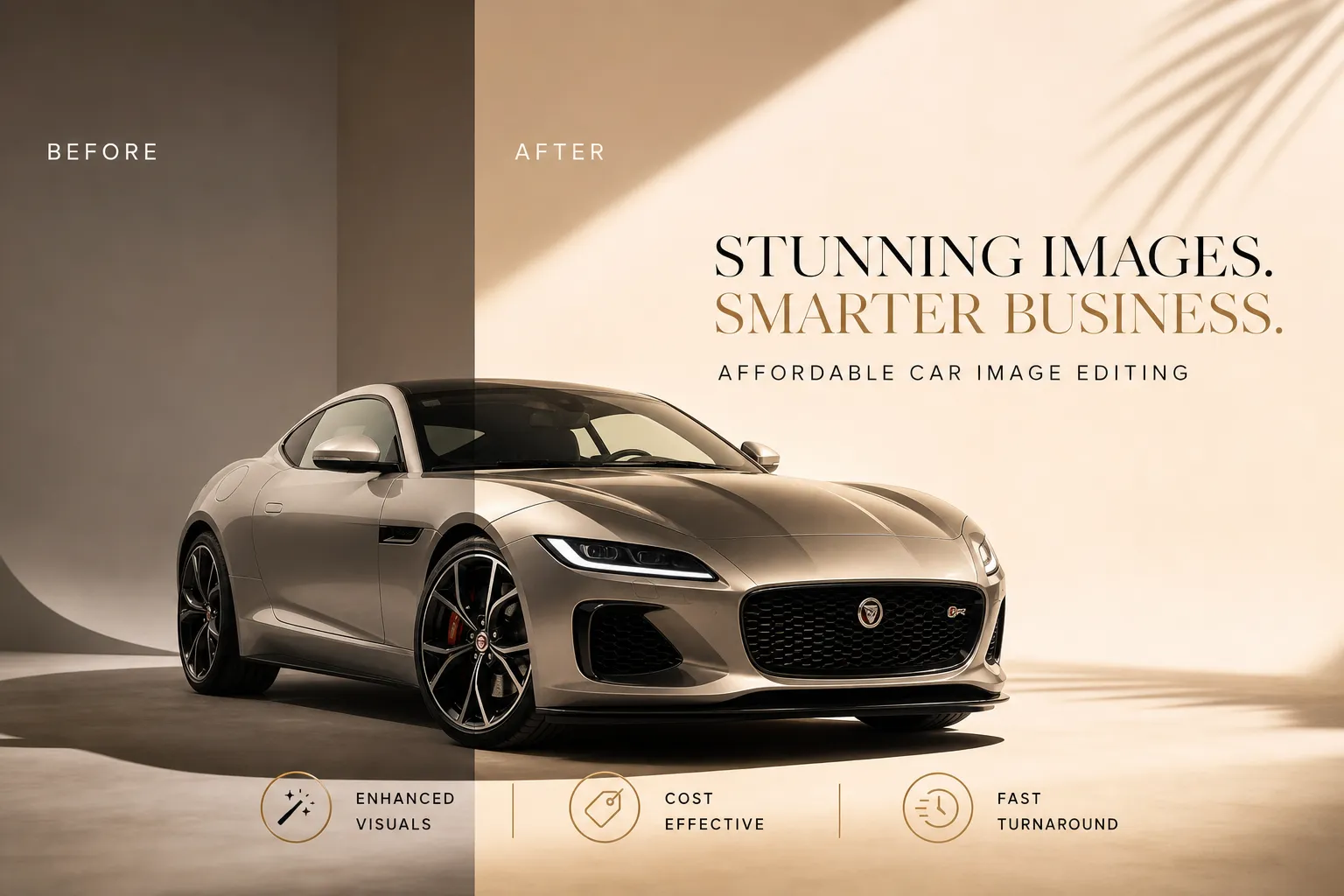
Proper automotive background replacement is more complex than standard product photo cutouts. It requires precise vehicle masking that includes mirrors, antenna tips, and wheel wells, plus clean edge separation from highly reflective surfaces like door panels and window glass. This is exactly where the quality difference between AI-processed and hand-edited results becomes immediately visible. Poorly masked wheel arches, haloed rooflines, or backgrounds bleeding through spokes are red flags that signal a service isn’t built for the complexity of vehicle imagery.
The replacement background itself matters too. A neutral gray gradient reads differently than a flat white, and a cloudy sky environment feels different from a studio floor. The right service gives you options that match your brand standard and your platform requirements, not just a single default output.
Shadow creation and depth realism
Three main shadow types are relevant to car listing photo editing. A natural shadow simulates the vehicle sitting on a real surface with correct directional lighting. A drop shadow creates a clean separation effect popular for white-background listings on AutoTrader and Cars.com. A reflection shadow produces the mirror-polish look used for brand campaign images and OEM creative. A service that offers only one shadow option may not be adequate for the full range of use cases a dealership or automotive brand has across platforms, print, and digital campaigns.
Color accuracy, correction, and interior consistency
Exterior color must be true to the vehicle’s actual finish, and this is harder than it sounds for metallic and pearlescent paints that shift dramatically under lot lighting or overcast skies. Interior shots almost always need white balance correction, highlight recovery on dashboards, and shadow lift on seats and door panels. These corrections directly affect buyer confidence in a digital purchase context where the photo is the only proxy for an in-person inspection.
360° vehicle photo editing and spin-ready output
360° vehicle photo editing is a growing requirement for OEM brand sites and premium dealership portals. Not every editing service supports spin-ready workflows, and most AI tools that handle single-image background replacement aren’t built to maintain consistent frame-by-frame background treatment and color synchronization across a full 36-frame or 72-frame turntable sequence. If your dealership uses turntable photography, confirming 360° capability during vendor evaluation is non-negotiable.
AI bulk editing vs. hand retouching: which model fits your workflow
What AI-automated editing actually delivers at dealership scale
AI tools built for automotive inventory, including platforms like Spyne, which documents processing a 15-image vehicle set in under 60 seconds, offer genuine speed advantages for franchise dealers uploading 30 to 50 vehicles per week. These platforms automate background removal, basic color correction, and watermarking in a single pipeline, and some offer DMS-ready file naming that reduces upload friction significantly.
The tradeoff is a quality ceiling. AI models trained on standard vehicle silhouettes often struggle with convertibles, lifted trucks, custom aftermarket builds, or any vehicle where the background bleeds into complex body lines. The most common failure modes are jagged edges around wheel arches, lost detail at rooflines, a floating-car appearance when ground shadows are removed incorrectly, and color shifts on glossy or pearlescent paint. For standard used-vehicle sedans and crossovers shot on a flat lot, AI tools deliver consistent, reliable results. For everything else, the gap shows quickly.
Where hand retouching pays off on vehicle images
Hand-edited automotive photo retouching catches what AI misses. A reflection of a parking cone in a door panel. A muddy wheel well that should have been cloned out. A blown-out sky that needs a natural-looking replacement matched to the vehicle’s lighting environment. These aren’t edge cases, they’re regular occurrences in real dealership inventory photography shot in uncontrolled lot conditions.
For hero images on brand websites, campaign creative, or premium CPO listings, hand retouching is not optional. The quality difference is visible at a glance to an attentive buyer. A professional editor also brings judgment that an algorithm doesn’t: knowing when to preserve a detail versus when to remove it, and when a vehicle’s unique features require a departure from a standard template.
The hybrid approach that high-volume dealers use
The most practical setup for a dealership processing large weekly inventory is a split workflow. Use AI automation for the bulk of standard used-vehicle listings where speed and consistency matter most. Route flagship new vehicles, certified pre-owned units, and brand campaign imagery through a hand-retouching service. This keeps costs controlled while protecting quality where it has the most impact on buyer perception and lead volume. A partner like Clipping Path One fits naturally into the hand-retouching side of that split, handling the complex inventory that AI tools reliably get wrong.
Platform image requirements dealers most often get wrong
AutoTrader and Cars.com compliance specifications
AutoTrader’s documented image requirements include a minimum resolution of 640 pixels on the longest side, with 1,600 to 2,400 pixels recommended for sharp display, a 4:3 aspect ratio for native gallery presentation, and JPEG or JPG file formats. Cars.com recommends a minimum width of 1,200 pixels, displays images in an approximately 4:3 gallery format, and accepts JPEG and PNG files. Both platforms enforce rules around overlaid text and graphic treatments that can cause listings to be demoted in search results or displayed with degraded presentation. Check each platform’s current help documentation to confirm any file-size limits or format updates before you finalize your delivery spec.
Dealers who upload non-compliant images often see their listings lose organic exposure before a single ad dollar is spent. Confirming these specs with your editing partner at the start of an engagement, rather than discovering compliance issues after the fact, is the single fastest way to protect your platform visibility.
OEM brand site standards and what they actually enforce
OEM-approved dealership websites operate under stricter creative guidelines than third-party listing platforms. Manufacturer brand standards often mandate specific background treatments, consistent logo-free zones, and shadow styles that align with national campaign creative. A dealership working with an editing service that doesn’t understand these constraints ends up with images rejected by the platform tool or flagged during co-op compliance reviews. Neither outcome is recoverable quickly when you’re on a monthly marketing cycle.
How to build a spec sheet your editing partner can follow
Document your own compliance spec sheet before you onboard any car listing photo editing partner. Include the required pixel dimensions for each platform you list on, acceptable background colors and treatments, watermark placement rules, and file naming conventions for DMS upload. Sharing this spec sheet at the start of an engagement eliminates revision cycles and cuts turnaround friction significantly. A professional service should be able to work from a written spec without needing repeated correction rounds.
Understanding pricing: per-image rates, subscriptions, and volume deals
The two main pricing models and what each signals about the service
Per-image pricing, typically ranging from $0.19 to $0.50 per vehicle image, suits dealerships with variable weekly inventory and those who want cost directly tied to output. Subscription tiers, ranging from roughly $19 per month for 50 images to $149 per month for 500 to 750 images from AI-first platforms, make sense for dealers with predictable, high-volume workflows. The key question is what’s included in that price: background removal only, or the full stack of shadow creation, color correction, format delivery, and revision rounds?
A subscription that covers 500 images per month sounds efficient until you realize revisions are billed separately, rush delivery costs extra, and the quality ceiling means your CPO and new vehicle units need additional editing anyway. Total cost of ownership matters more than the headline rate.
What $0.29 per image should get you from a professional service
At Clipping Path One’s starting rate of $0.29 per image, dealers receive hand-edited automotive retouching with background removal, shadow application, and color correction performed by a trained editor rather than an algorithm. Bulk discounts are available for high-volume accounts, the service operates 24/7, and quotes come back within one hour. That price point removes the argument that quality requires a premium subscription commitment. Professional hand editing is accessible even for large inventory workflows when the pricing is structured this way.
The pay-only-when-satisfied billing model changes the risk calculation entirely. You’re not committing to a monthly fee and hoping the output meets your standard. You review the work and approve it before the invoice is finalized, a fundamentally different vendor relationship than a prepaid subscription to an AI platform.
Hidden costs that inflate the real price of cheap services
Watch for revision fees after the first round, rush delivery surcharges for same-day turnaround, additional charges per image format (web JPG versus print TIFF versus PNG with transparency), and setup fees for FTP or Dropbox delivery configuration. A service priced at $0.20 per image that charges $0.10 per revision and $30 per month for FTP access is not cheaper than a $0.29 service with free revisions and flexible file delivery included. Running a realistic cost model against your actual revision rate and delivery requirements before committing to any vendor is worth the 30 minutes it takes.
How to choose the best car photo editing service for your dealership or brand: top options in 2026
Clipping Path One: built for hand-edited, high-volume dealership workflows
Clipping Path One is the clear choice for dealerships and automotive brands that need pixel-perfect results at scale. Starting at $0.29 per image, with hand retouching on every file rather than AI automation, 24/7 availability, one-hour quote delivery, and a pay-only-when-satisfied billing model, it solves the core problem most dealerships face: finding a single reliable partner that handles everything from background replacement and shadow creation to 360° frame editing and bulk delivery via FTP or Dropbox. That breadth means dealers don’t need to manage separate vendors for different image types or quality tiers.
For dealerships managing a mix of standard used inventory and premium CPO or new vehicle imagery, Clipping Path One’s ability to scale across both without a quality drop is the defining advantage. One partner, one standard, one delivery workflow.
AI-first platforms: Spyne, WheelStage, and CarPixAI
These are practical tools for specific use cases: high-speed bulk processing for standard inventory, automated watermarking and DMS-ready file naming, and subscription models suited to predictable monthly volumes. Spyne documents processing vehicle sets in under 60 seconds. WheelStage offers a self-service model at $0.19 to $0.38 per image, and CarPixAI tiers range from $19 to $149 per month based on volume. These platforms earn their place in a dealership workflow for standard used-car sedans and crossovers. They should not carry the full weight of brand-level or premium inventory editing, where the quality ceiling becomes visible quickly.
Mid-range human retouching alternatives
Services like Pixofix ($0.20 per image, 24-hour turnaround) and CarPhotoFix (approximately $0.50 per image, 48-hour standard delivery) occupy the space between AI speed and full-service hand editing. These are options dealers can consider for specific use cases, though pricing and turnaround alone don’t reveal quality. Always request a test batch before committing to any volume agreement with an unfamiliar provider, and hold the returned images to the same quality benchmarks you’d apply to any other vendor.
How to run a vendor trial and lock in your final pick
What to send in your test batch
Select 5 to 10 images that represent the actual complexity of your inventory. Include one vehicle with a challenging reflective paint finish, one convertible or lifted truck with a non-standard roofline, one interior shot with mixed lighting, and one standard sedan for baseline comparison. If you use turntable photography for 360° listings, include one full spin set. This test batch reveals more about a vendor’s real capability than any sales call or curated portfolio they show you.
Don’t send your easiest images. Send the ones that have caused problems with previous editors. A vendor’s response to your most difficult material is the only honest preview of what the ongoing relationship will look like.
The quality benchmarks to evaluate before you commit
When the test batch comes back, assess these specific elements: edge cleanliness on mirrors and antennas, shadow realism and consistency across the full set, color accuracy checked against the manufacturer’s published color sample for that model year, background uniformity without banding or tonal variation, and whether the final files meet your platform’s dimension and format requirements without additional conversion work. Any vendor worth committing to should clear all five without revision on a clean test batch.
Questions that separate a scalable partner from a one-off vendor
Ask about daily capacity: can they handle your peak upload week, typically a Monday after a strong weekend of trade-ins, without extending turnaround beyond your standard SLA? Ask about revision policy: how many rounds are included, and at what cost? Ask about the communication channel during active jobs, the file delivery method, and whether they have direct experience with AutoTrader and Cars.com compliance specs. A vendor that has processed dealership inventory at scale will answer all of these without hesitation.
One that hasn’t will hedge, ask for clarification, or give a generic answer. That difference matters when you’re uploading 80 vehicles on a Monday morning and need confidence that Tuesday’s listing push goes out clean. The vendor trial is your only real opportunity to surface these gaps before they become operational problems.
Choosing the best car photo editing service for your dealership or brand
The right service depends on what your brand images actually require, how much volume your workflow produces each week, and how much accountability you need from a vendor. AI platforms earn their place in speed-first, standard-inventory workflows where volume is high and vehicles are straightforward. When quality, consistency, and platform compliance need to hold across every image in a large and varied lot, hand editing from a service like Clipping Path One is the more reliable foundation.
Start with a test batch. Hold vendors to a concrete benchmark, not a portfolio impression. Don’t lock into a subscription or volume contract until the output earns it. The best car photo editing service for your dealership or brand is the one that makes your inventory look exactly as good as it deserves to, every week, at a price that doesn’t require a separate budget line to justify.
Send your most challenging inventory batch to the Clipping Path One team. Quotes come back within one hour, and you pay only when the work meets your standard.
FAQ’s:
Why should my dealership use a professional car photo editing service?
Research from AutoTrader and Dealer.com indicates top-quartile vehicle photos generate up to 40% more Vehicle Detail Page views, and listings with professional images are 30 to 40% more likely to generate an inquiry. Professional editing sharpens that crucial first impression and significantly increases the chance a shopper clicks or submits a lead.
How does photo quality affect how fast vehicles sell?
Listings with 20 or more images sell approximately 32% faster than those with fewer than 10, and industry data shows professionally edited images consistently accelerate sale timelines by 20 to 36%. Dealer.com also cites professional photography as moving vehicles 5 to 10 days faster on average, which directly reduces carrying costs and improves turn.
What specific editing features should I require from a car photo service?
Look for proper automotive background replacement and studio-consistent presentation, plus precise vehicle masking that includes mirrors, antenna tips, and wheel wells. The service should deliver clean edge separation from highly reflective surfaces, consistent color and exposure across listings, and uniform background treatments to protect brand trust.
What questions should I ask during a vendor trial to compare photo-editing services?
Ask about turnaround time and guaranteed throughput at dealership scale, batch pricing and per-image cost, and whether they provide live samples or A/B-ready edits. Also confirm how they handle reflections and fine masking, their revision policy, file formats and platform integrations (e.g., Cars.com or Dealer.com workflows), and measures for consistency across an entire inventory.
How much impact can better photos have across a 100-unit lot?
Across a 100-unit lot, even a modest lift in click-through rates translates to dozens of additional qualified prospects every month, since shoppers quickly compare listings at the same price point. Faster engagement and higher inquiry rates compound across the inventory and can meaningfully increase monthly lead volumes.
Why does inconsistent photo presentation hurt my brand?
Inconsistent background treatments, clipped reflections, or color-washed interiors signal unprofessionalism and erode buyer trust even when shoppers can’t articulate why. Platform shoppers compare many dealers side-by-side, and inconsistent photos make it harder to compete for attention and are difficult to overcome once a buyer moves on.
Can investing in professional editing pay for itself through lower carrying costs?
Yes — improved photos accelerate sale timelines (20–36% faster in industry data) and can move vehicles 5 to 10 days faster on average per Dealer.com, reducing days-to-sale and floor-plan interest. On a typical 60-day days-to-sale cycle, shaving even a few days through better imaging often more than covers the cost of professional editing.