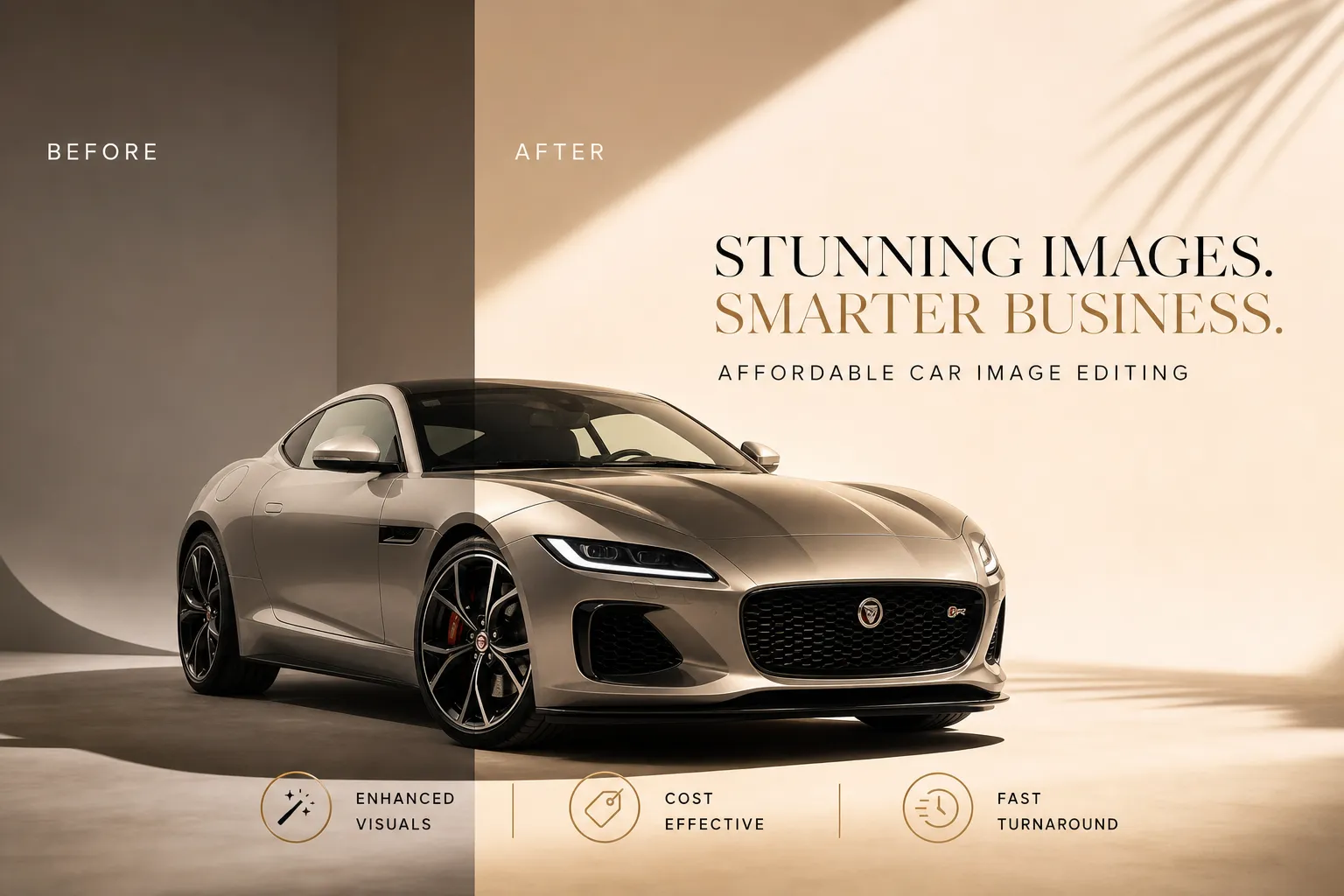
Affordable Car Image Editing Solutions for Automotive Brands
When dealerships invest heavily in digital advertising but upload poorly lit, cluttered lot photos, the resulting low VDP engagement is rarely traced back to its actual cause: the images. Finding affordable car image editing solutions for automotive brands has become a concrete operational priority precisely because the data shows how much those images control. Dealer.com research found that listings using multiple custom photos generated a 349% increase in used-vehicle VDP clicks compared to stock imagery. AutoTrader data shows that listings with 11 or more photos generate 205% more detail-page views and 185% more leads for used inventory. Photos are a major driver of that gap, not a marginal one.
Many dealerships invest tens of thousands monthly in digital advertising, yet the listing photos those ads point to actively suppress clicks. The good news is that professional photo editing no longer requires a large agency retainer. The market in 2026 offers outsourced human editing starting at $0.29 per image, AI-powered tools built specifically for automotive inventory, and API-driven platforms that can process an entire dealer group’s uploads automatically. The challenge is matching the right approach to your volume, your budget, and your workflow without overpaying for features you don’t need or undershooting on quality where it matters. This article lays out exactly how to do that, with the pricing numbers to back every decision.
What bad vehicle photos are actually costing you
The lead loss you can’t see on a report
VDP visitors who interact with photos are 16% more likely to submit an inventory lead than visitors who scroll past without engaging, according to Dealer.com research. That means every time a shopper lands on a listing with a dark, blurry, or cluttered image and keeps scrolling, the dealership loses a lead it never knew it had. Listings with actual photography are 30% more likely to generate a lead for new vehicles and 40% more likely for used and CPO inventory. Photos are a primary revenue driver here, not a secondary presentation concern. Bad photos don’t just fail to convert, they actively suppress clicks before a shopper ever reads the vehicle description or sees the price.
The problem is invisible on most standard reports because the lead was never created. What shows up is a low engagement rate, a high bounce rate, and a cost-per-lead that keeps climbing as the ad budget works harder to compensate for listings that aren’t doing their job.
How photo volume compounds the effect
Quality and quantity aren’t competing priorities, they work together. A single polished hero shot won’t move the needle the way a full image set does. AutoTrader data shows that listings with 11 or more photos generate 205% more VDP views and 185% more leads for used inventory, and listings with 40 or more photos saw 64.8% higher VDP views per listing compared to those with fewer images. Editing one showcase image is not the strategy. Editing every image in a complete per-vehicle set, consistently and at scale, is where the ROI compounds into something measurable quarter over quarter, which is why dealership inventory photo editing at volume produces fundamentally different outcomes than one-off retouching.
The speed-to-sale advantage
Professionally edited listings sell 5 to 10 days faster on average, based on industry benchmarks from Dealer.com and AutoTrader. For a dealer principal, that number lands differently than it does for a marketing manager. A vehicle sitting on the floor plan for 10 extra days carries real carrying costs in interest, insurance, and lot space. Multiply that across 20 or 30 units per month and the editing investment becomes very easy to justify on a spreadsheet. AutoTrader research shows that listings with 20 or more images sell 32% faster than those with fewer than 10. The image set functions as a direct turn-rate lever, one with a measurable, repeatable effect on days-to-sale.
Affordable car image editing solutions for automotive brands: pricing and approaches
Outsourced human editing services
The outsourced model works like this: you send batches of raw vehicle photos to a specialized service, trained editors apply the agreed edit set, background removal, shadow work, color correction, and any additional retouching, and you receive finished files within a defined turnaround window. The main advantages are consistent output quality, no software investment, a predictable per-image cost, and the ability to scale volume up or down without adding headcount. Per-image pricing in this category typically runs from $0.24 at the low end to $5.00 for more complex retouching, with the most useful range for dealership inventory photo editing sitting between $0.29 and $1.00.
Human editing has a clear advantage on difficult shots: reflective paintwork, chrome trim, glass-heavy profiles, and tight wheel well cutouts. Trained editors make judgment calls that automated tools still miss regularly, which matters when the image represents a $40,000 vehicle to a buyer who hasn’t seen it in person.
AI-powered car photo editing tools
AI-driven platforms automate background swaps and basic cleanup, often processing a full vehicle set in minutes. They work well for high-volume, lower-complexity inventory photos, particularly ads, listing thumbnails, and social content where the standard is functional rather than exceptional. The trade-off is consistency on edge cases. Vehicles with deep metallic finishes, heavy chrome trim, or complex lot backgrounds frequently expose the limits of automated processing, producing artifacts, incorrect reflections, or halos along edges. Pricing for these tools tends to be per-vehicle or per-credit rather than per-image, with typical subscription tiers in the $39.99-per-month range for lower image counts up to approximately $149.99 per month for higher volumes, figures that vary by provider and should be confirmed directly with each vendor before committing.
API-based solutions for marketplace-scale workflows
For large dealership groups, marketplace platforms, and inventory aggregators, API-driven editing tools allow direct integration with inventory management systems. Images move through the editing pipeline automatically without manual upload, removing the handoff entirely and reducing the operational overhead of managing a photography workflow at scale. Providers like Autobackgrounding offer enterprise plans with API access, inventory system integration, and priority support. These are the highest-investment option to set up, but they make financial sense at very high volumes where manual intake is itself a bottleneck. The threshold where API integration typically pays for itself is 500 or more vehicles per month, or any operation where inventory images need to be live within hours of a vehicle arriving on the lot.
Per-image cost breakdown: what each pricing tier actually delivers
Entry-level: $0.24 to $1.00 per image
This is the most relevant range for dealership inventory at scale. At this price point, a quality outsourced service handles background removal, basic color correction, and standard shadow creation. A 150-vehicle inventory with 8 images per car produces 1,200 edits per refresh cycle. At $0.29 per image, that’s $348 for a full inventory edit. Compare that to the floor-plan cost of one unsold vehicle sitting for an extra week, and the editing budget becomes a rounding error relative to the potential return. This tier is where most dealerships should start, and for many, it’s the only tier they ever need.
Mid-tier retouching: $1.00 to $5.00 per image
At this price range, expect more detailed retouching: reflection correction on painted surfaces, blemish removal on bodywork, advanced color grading for cinematic presentation, and layered file delivery. This tier suits flagship model landing pages, OEM campaign materials, or editorial-style content for a brand refresh. It’s not practical for everyday inventory at scale, but it’s the right investment when the image needs to carry more weight than a listing click. A regional dealer launching a certified pre-owned program with premium positioning is a good example of when mid-tier retouching earns its cost.
Premium and per-vehicle package pricing
High-end composites, showroom-quality imagery, and custom background scenes fall into the $5 to $20 or more per image range. Full per-vehicle packages for this tier can run $50 to $100 or higher depending on deliverable count. This level of investment makes sense for vehicle launch campaigns, OEM-certified programs, and brand-level advertising rather than individual listing photos. Most dealerships will use this tier for a specific model launch or a flagship vehicle, not as their standard inventory workflow.
Editing features every automotive brand needs in 2026
Background removal and replacement for inventory listings
Background removal is the most requested edit across all volume tiers. Clean white or neutral backgrounds increase perceived vehicle value and meet the presentation standards of all major listing platforms. What separates quality background removal on a vehicle from a mediocre result is the precision on the hard parts: clean wheel wells, accurate tire edges, no color bleed from reflective paint, and no halo artifacts around chrome surfaces. Hand-edited background removal holds up on reflective paintwork and glass-heavy profiles in a way that generic AI tools still don’t reliably match. For inventory that spans dozens of models, colors, and body styles, that consistency matters across the full set.
Shadow creation: natural, drop, and reflection
A vehicle with no ground shadow looks like it was cut out and pasted onto a blank page. Professional automotive image retouching uses three shadow types for specific purposes. A natural shadow creates a soft, directional cast as if the vehicle were lit from one side. A drop shadow projects a controlled downward shape for a grounded look. A reflection shadow mirrors the vehicle on a simulated surface beneath it, which is commonly associated with premium brand presentation and high-value listings. Each type communicates something different about production quality, and the choice should match the intended platform and audience. Shadow creation significantly affects the realism and trust signal of the finished image, especially for buyers evaluating a vehicle they haven’t seen in person.
Color correction and consistency across an inventory set
Color accuracy matters for two reasons: buyer trust and brand consistency. A red SUV that photographs as orange or burgundy creates expectation problems the moment a buyer shows up at the lot. Inconsistent color grading across a multi-vehicle inventory makes the page look unprofessional regardless of how good any individual image is. Professional car photo editing services apply color correction to match actual paint codes, ensure consistency across lighting conditions from different shoot days, and maintain a brand-standard look across the full inventory set. For dealership groups with multiple locations and separate photographers, systematic color normalization is one of the strongest arguments for outsourced automotive image retouching over in-house DIY processing.
Bulk workflows and turnaround: matching your volume to the right vendor
High-volume intake: FTP, batch upload, and API
Professional editing vendors typically receive large image batches through one of three channels. FTP and cloud folder sharing via Dropbox or Google Drive work well for dealerships with weekly or bi-weekly upload cycles. Batch upload portals suit mid-volume users who prefer a self-service interface without setting up a file transfer system. API integrations suit enterprise-grade operations where images need to flow from the DMS or inventory platform directly into the editing pipeline without manual handoff. For most independent and regional dealerships, a cloud folder setup is the fastest way to start and easy enough to maintain without dedicated IT support.
Realistic turnaround benchmarks by volume
For small batches of 5 to 100 images, a professional editing service should deliver within 12 to 24 hours. Medium batches of 500 to 5,000 images typically take 24 to 48 hours. True enterprise volumes of 30,000 or more images per month require a dedicated vendor conversation and a formal SLA. 24/7 availability matters more than most dealerships initially expect. A vendor that only processes during business hours can’t support a Monday-morning sales push when the photography was completed over the weekend, and weekend shoots with Monday-morning go-live timelines are a standard part of the automotive retail cycle.
Revision policies, file formats, and delivery terms
Before committing to any vendor, confirm the revision policy: free revisions until specs are met, or a fixed number of included rounds? Several professional editing services explicitly offer revisions until the output matches the written specification, which removes ambiguity and protects the dealership’s time. On file formats, confirm that the vendor accepts RAW, PSD, and TIFF alongside standard JPG and PNG as inputs, and clarify whether output files are delivered as layered PSDs or flattened JPGs only. For OEM-level content or pre-release model photography, also confirm NDA and confidentiality terms before transferring files. These contract details matter as much as the per-image price when evaluating a long-term editing partner.
Clipping Path One: professional automotive editing at $0.29 per image
What’s included at the base price
Clipping Path One delivers hand-edited background removal, clean cutouts on complex vehicle profiles, and consistent output ready for listing platforms, starting at $0.29 per image. Every edit is completed by a trained human editor, not an algorithm. That distinction shows up directly on reflective paintwork, chrome trim, and glass-heavy shots, the exact vehicle types where AI tools produce artifacts and inconsistent edge quality. For dealerships running diverse inventory across multiple makes and body styles, that hand-edited precision means the output holds up across the full set, not just the easy shots.
Bulk pricing and scalability for dealership inventory
Bulk discounts make the economics practical for dealerships of every size. A small independent lot with 80 vehicles on the ground pays a fraction of what a traditional agency would charge per deliverable. A regional dealership group processing 200 or more vehicles per week can negotiate rates that make per-image cost predictable and budgetable as a fixed line item. According to Clipping Path One, quotes are delivered within one hour and the team is available around the clock, which means a shoot completed Saturday afternoon can be queued for Monday-morning delivery without waiting for a business-hours response. That operational reliability is what separates a professional editing service from a freelancer arrangement.
The pay-after-satisfaction model
Clipping Path One operates on a pay-only-when-satisfied billing model, which removes the financial risk of committing to a new vendor before proving output quality. Images arrive, the team reviews them against the agreed specifications, and payment follows approval. For a dealership making its first move into outsourced editing, this structure matters. Many subscription-based tools charge regardless of output quality, leaving the buyer with limited recourse if the results don’t meet standard. The pay-after model places the burden of quality on the editing service, where it belongs. A test batch request confirms output quality before any volume commitment is made, contact the Clipping Path One team directly to arrange one.
Calculating your editing ROI before committing to a vendor
Cost-per-image vs. revenue impact per vehicle
The calculation follows a clear path. Take the per-image cost, multiply by average images per vehicle, and compare to the revenue lift from professional photos. As a working scenario: if edited listings generate even a modest lead uplift, consistent with the engagement gains documented by Dealer.com and AutoTrader, and the dealership closes at 15%, the incremental revenue from additional closes far exceeds the editing cost for the entire batch. At the $0.29 to $1.00 per image range, the math almost always favors the investment. The exact return varies by inventory mix and average gross, but the directional case is not a close call.
When AI tools make economic sense vs. human editing
This isn’t a binary choice between AI and human editing. AI tools offer speed and low marginal cost when the vehicle set is straightforward and the output doesn’t need to meet premium standards. They work well for social ads, remarketing banners, and lower-priority used inventory where the goal is functional presentation rather than brand-level quality. Human editing is the right call when image complexity is high, dark colors, chrome, glass, when the brand reputation is directly tied to image quality, or when consistency across a large mixed-inventory set is non-negotiable. The practical answer for most dealerships is to use AI tools for high-volume, low-stakes use cases and outsourced human editing for the inventory photos that drive VDP engagement and leads.
Estimating a monthly editing budget for your inventory size
Use this calculation: inventory size multiplied by average images per vehicle, multiplied by your editing tier price equals your monthly editing budget. A 120-vehicle inventory with 8 images per car at $0.35 per image average comes to $336 per month. A 250-vehicle regional group at the same spec comes to $700 per month. Frame that against what the same dealership spends monthly on digital advertising, and the editing budget is typically less than 5% of the ad spend while directly affecting how well every ad landing page converts. In most cases, the quality gap in existing photos is the binding constraint, not the editing cost.
How to pilot and scale your chosen solution
Running a structured test batch
Don’t commit to any vendor or tool at full scale without a test batch first. Send 20 to 50 representative images, and make sure to include challenging shots: dark-colored vehicles, chrome trim, glass-heavy angles, and tight wheel well shots from multiple perspectives. This exposes output quality across edge cases, not just the easy conditions where every tool performs adequately. Evaluate the actual turnaround time against the stated SLA. Compare the edited output to your current listing photos and document the visual difference. A structured test like this gives you real data to make a confident decision, not a sales demo designed to show the tool at its best.
Evaluating the output against specific quality criteria
Define the evaluation checklist before the test batch arrives so the review isn’t subjective. Check for clean background edges without fringing or halos, accurate shadow type and placement, color accuracy against known paint codes for at least three vehicles in the batch, consistent brightness and contrast across the full set, and correct file format delivery matching your specification. A structured checklist prevents disagreements about whether the output is “good enough” and creates a replicable standard the vendor can be held to on every future delivery.
Scaling to full inventory and integrating with your workflow
Once a vendor passes the pilot, integrate their intake method into your existing photography workflow. Map the upload schedule to your vehicle acquisition cadence so edited images are ready when new inventory needs to go live. Set a standing turnaround expectation with the vendor in writing. Assign one team member to quality-check incoming edited batches before they publish, using the same checklist from the pilot phase. Review output quality quarterly and renegotiate pricing as volume grows, most professional editing services offer lower per-image rates at higher volume tiers, so as your inventory scales, your cost per edit should come down accordingly.
Making the decision and moving forward
Understand your monthly image volume and match it to the right editing approach: outsourced human editing for quality and consistency at inventory scale, AI tools for high-volume lower-stakes use cases, and API integration for enterprise-level automation at 500 or more vehicles per month. Verify the pricing against the ROI math before committing, and always run a structured test batch before scaling. The decision framework follows your volume, it doesn’t require a large upfront investment to get right.
Affordable car image editing solutions for automotive brands don’t require a large agency budget to deliver agency-level results. Clipping Path One offers hand-edited background removal, shadow creation, color correction, and high-end retouching under one roof, starting at $0.29 per image with a pay-after-satisfaction model and the operational availability to support automotive retail timelines. The full range of services scales from a 50-vehicle independent lot to a multi-location dealer group without requiring multiple vendor relationships or workflow changes as volume grows.
The dealerships that treat image editing as a repeatable, budgeted workflow, with the right vendor, consistent standards, and a structured pilot behind them, are the ones compounding lead and sales-speed advantages every quarter. Get in touch with the Clipping Path One team to request a quote, submit a test batch, and see exactly what professionally edited inventory photos look like on your listings before committing to any ongoing spend.