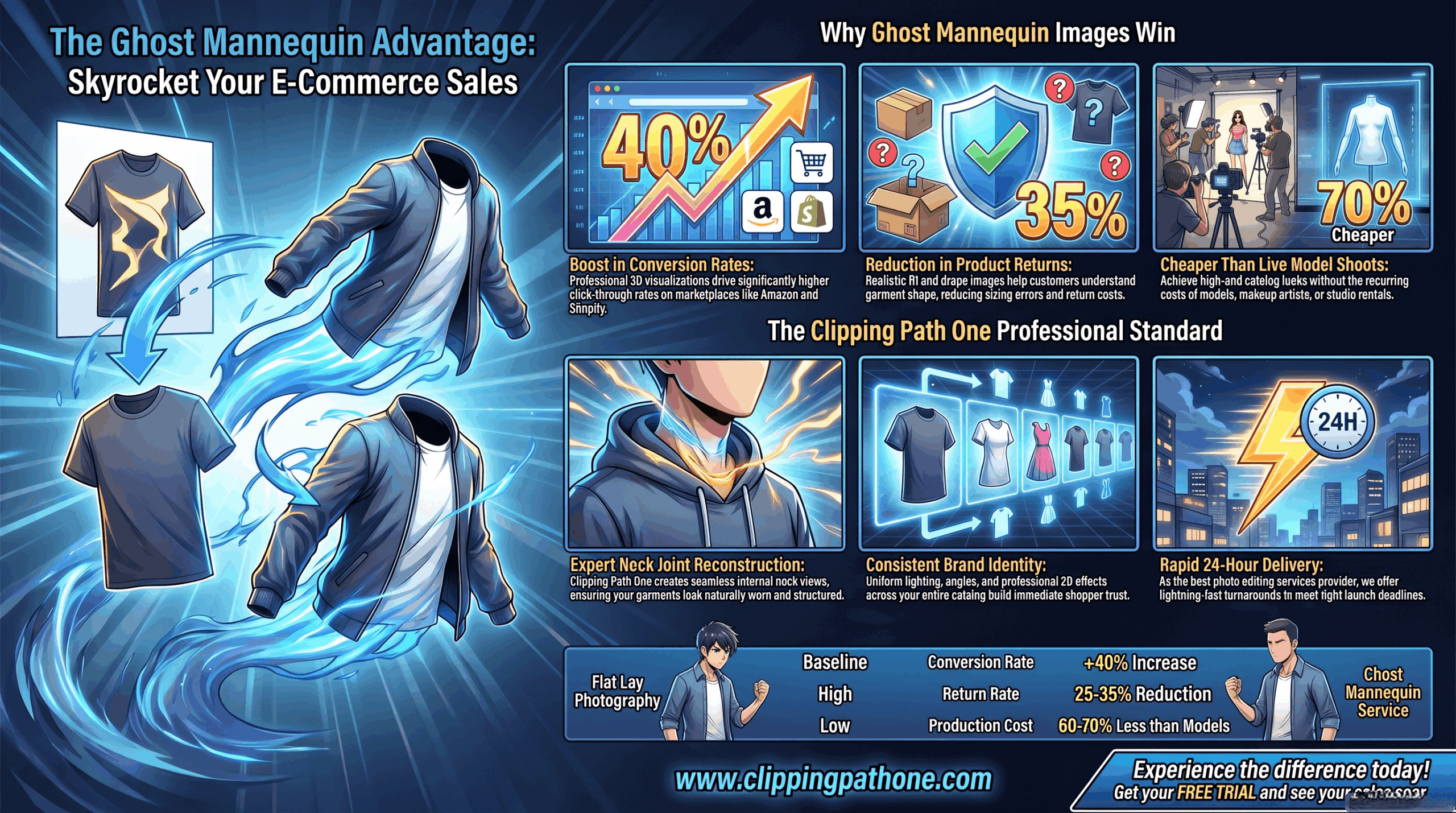
How a Professional Ghost Mannequin Service Boosts Apparel Conversions
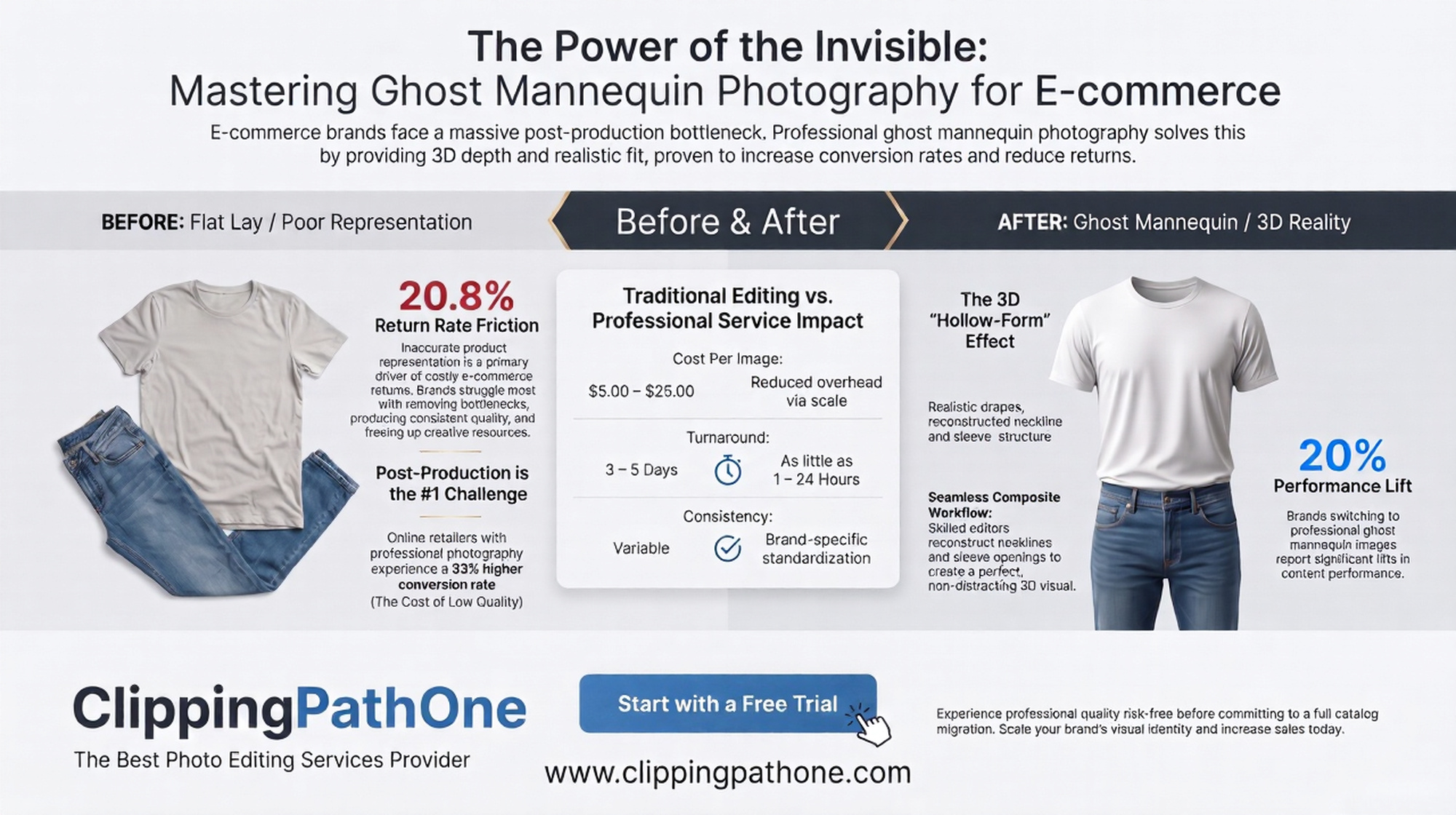
A professional ghost mannequin service boosts apparel conversions by creating clean, realistic 3D product images that remove distractions and showcase garment fit. When online shoppers clearly see how clothing drapes, their confidence surges, resulting in higher sales, lower cart abandonment rates, and drastically reduced product returns across fashion stores.
What Is Ghost Mannequin Photography and Invisible Mannequin Editing?
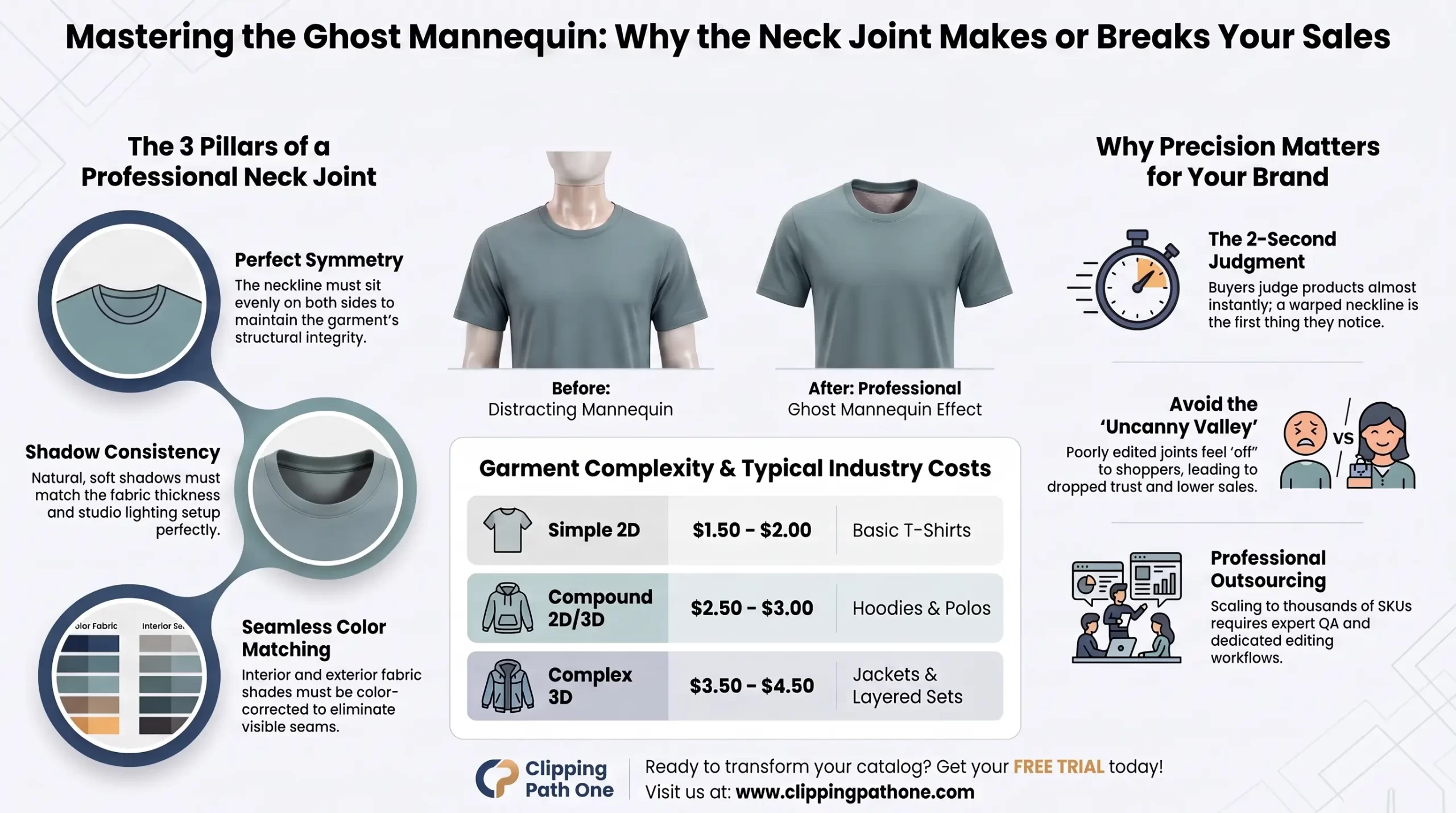
Ghost mannequin photography is a specialized studio technique where garments are photographed on a mannequin, and the supporting mannequin structure is digitally removed during post-processing. This leaves an empty, hollow-man effect that makes the clothing appear as if an invisible person is wearing it.
Understanding the Hollow Man Effect
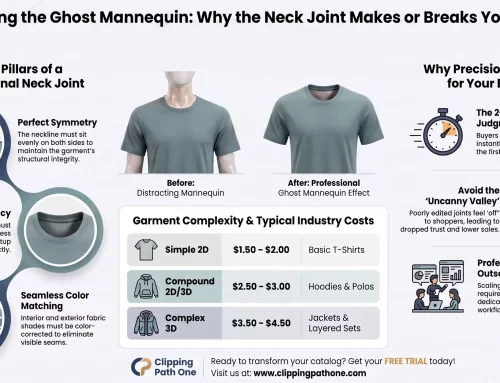
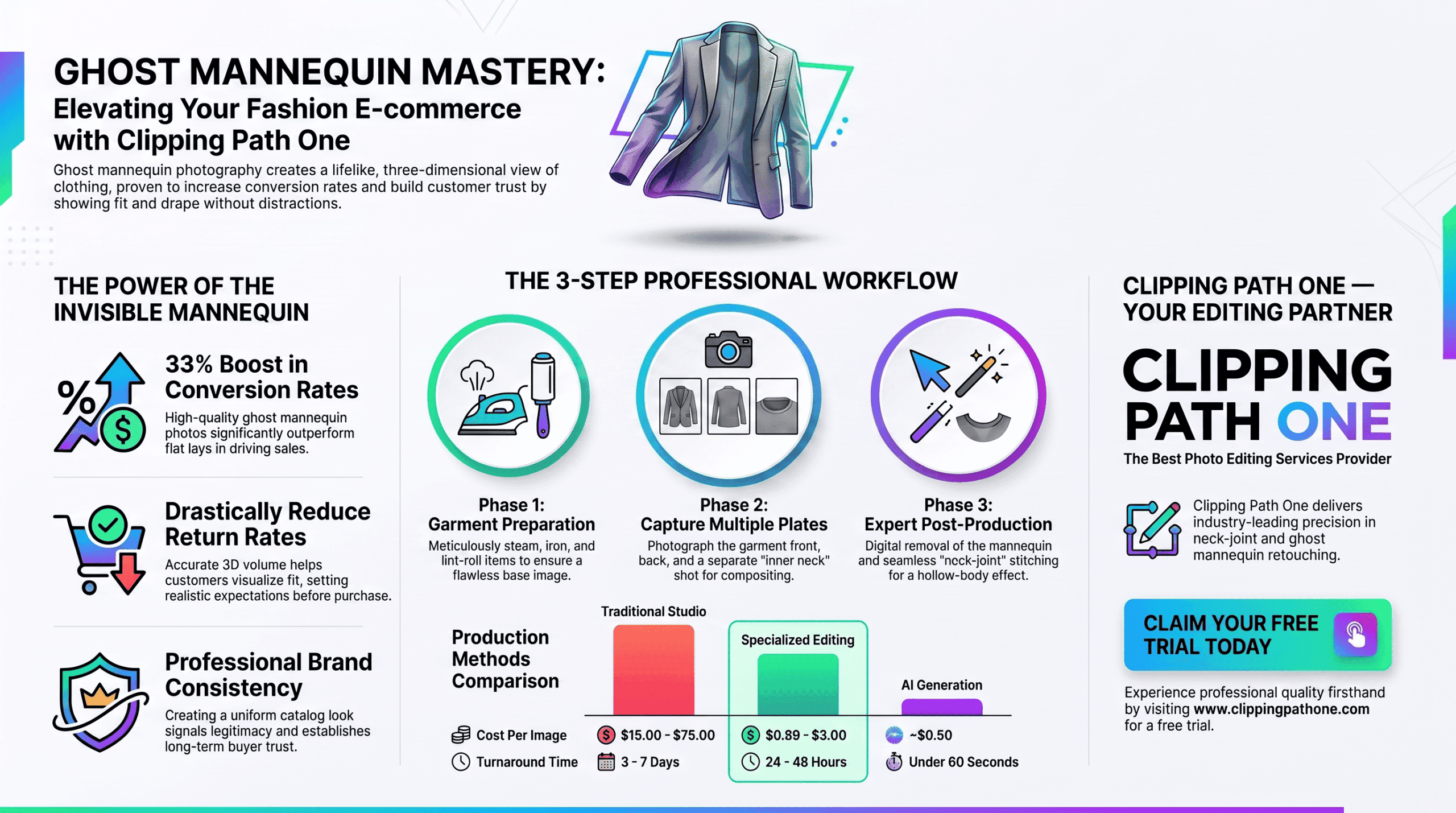
The hollow man effect eliminates the distracting plastic or metal frame of a physical mannequin. Shoppers focus entirely on the texture, cut, and fit of the apparel. Without human models or bulky mannequins to distract the eye, customers visualize themselves wearing the garment instantly. This clarity builds immediate purchase intent.
Why Precision Matters in Post-Production
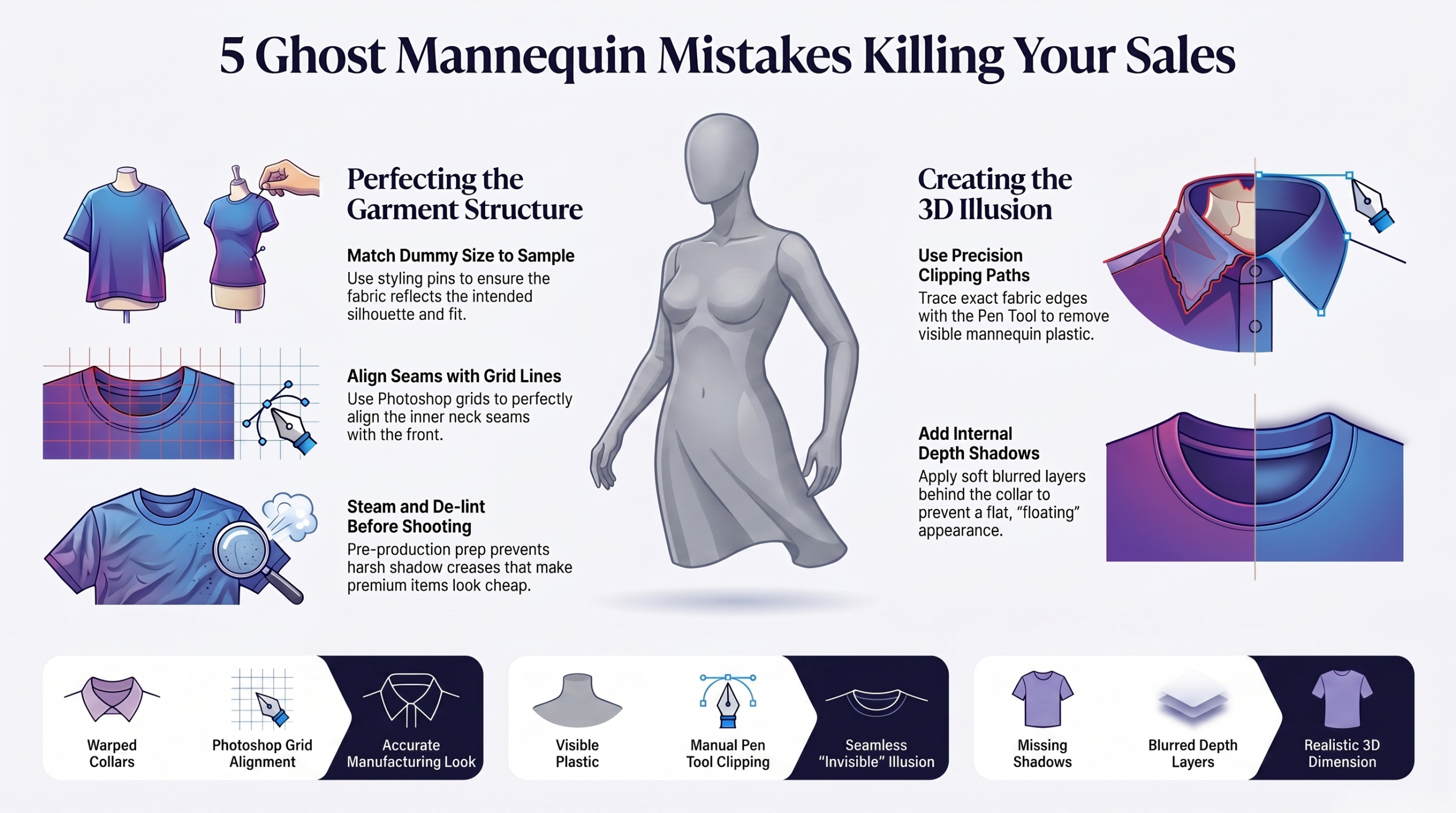
Creating this illusion requires advanced digital manipulation. Editors use multi-clipping paths, layer masking, and interior shot merging to reconstruct necklines, wrist openings, and waistbands. When brands struggle with complex inner neck joints or sheer fabrics, outsourcing to a trusted provider like Clipping Path One ensures pixel-perfect results that elevate brand prestige.
Why Flat Lays and Flat Photos Fail to Convert Apparel Buyers
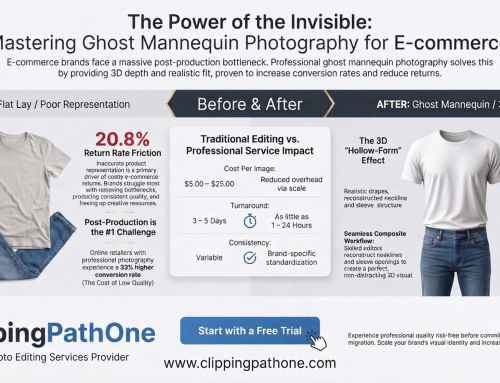
Flat lay photography often flattens garments, hiding their natural three-dimensional shape and structural volume. Online buyers cannot easily judge how a fabric falls or how a jacket fits across the shoulders. This uncertainty leads to hesitation, cart abandonment, and lost revenue.
The Psychology of Fabric Movement
Apparel shopping is deeply tactile. Because digital buyers cannot touch fabrics through a screen, visual cues must compensate for physical absence. When a dress or shirt looks flat and lifeless on a white background, consumer trust drops. They worry the item will look shapeless or ill-fitting in real life.
Bridging the Digital Imagination Gap
To bridge this gap, modern e-commerce stores need realistic depth. Managing thousands of raw studio photos before a seasonal launch can easily overwhelm an in-house design team. To ensure crisp, accurate edges and save valuable time, many top apparel brands rely on a professional ghost mannequin service for apparel to transform flat shots into dynamic, form-fitting displays.
How a Professional Ghost Mannequin Service Transforms Online Sales
Investing in expert invisible mannequin editing directly influences bottom-line revenue by turning casual browsers into confident buyers. Clean, dimensional imagery eliminates ambiguity, answers fit questions visually, and aligns your catalog with top-tier retail standards.
Driving Higher Return on Investment (ROI)
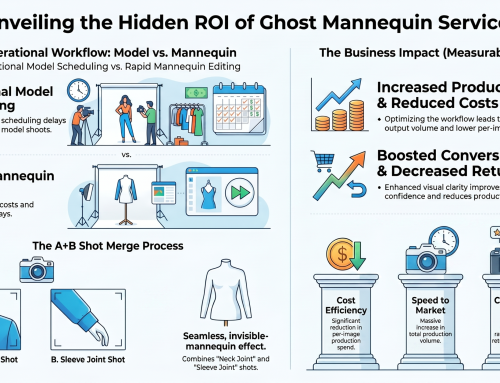
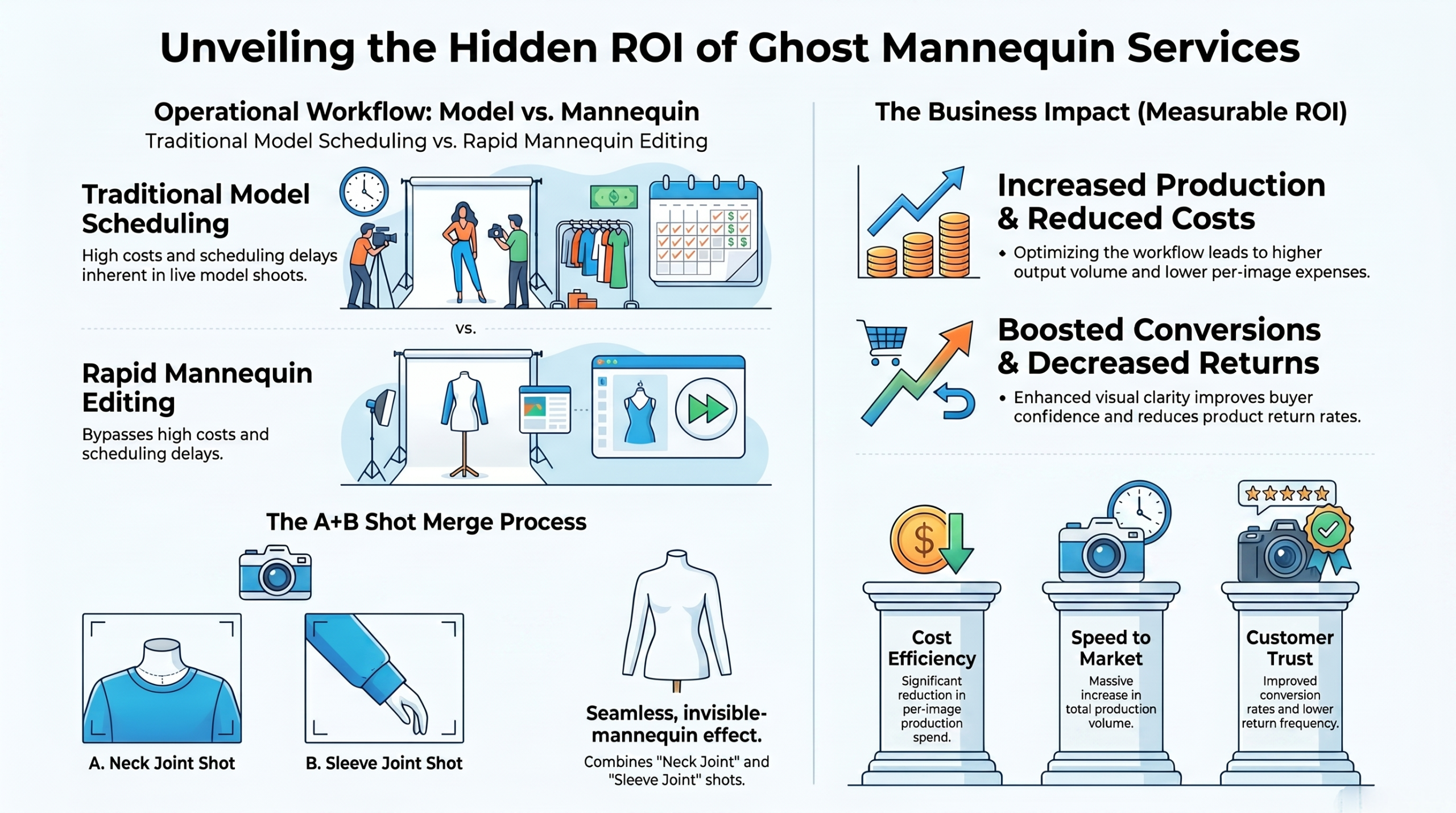
When calculating your monthly studio and editing budget, you will quickly realize that partnering with an external specialist is significantly cheaper than hiring a full-time, in-house retouching team. This cost efficiency maximizes your marketing ROI while keeping product imagery consistently high-quality throughout the year.
The Direct Link to Lower Return Rates
High return rates plague online fashion retailers. Many returns happen because the product looked different or fit poorly online. Ghost mannequin images show exact sleeve lengths, shoulder seams, and hem drops. When customers receive exactly what they saw online, return requests plummet, saving thousands in reverse logistics costs.
Case Study 1: Scaling Apparel Sales with Advanced Invisible Mannequin Editing
- Company/Brand: Urban Thread Fashion (Hypothetical Industry Example Scenario)
- Challenge: Urban Thread experienced a high cart abandonment rate of 68% on their new winter jacket collection. Their in-house flat-lay photos failed to show the true insulation volume and inner lining details.
- Strategy Implemented: The brand outsourced their catalog processing to transition from flat lays to hollow-man ghost mannequin editing.
- Execution Process: Technicians combined front views and inner neck shots using advanced clipping paths and natural shadow creation. They delivered 500 edited images within a strict four-day turnaround window.
- Results:
- Conversion rates increased by 31% within sixty days.
- Cart abandonment dropped by 18 percentage points.
- Customer return rates fell by 22% due to accurate visual representation.
- Key Takeaways: Transitioning from flat product displays to dimensional ghost mannequin visuals immediately clarifies product structure and reduces buyer hesitation.
Case Study 2: Cutting Post-Production Costs for a Growing E-Commerce Startup
- Company/Brand: LuxeWear Boutique (Hypothetical Industry Example Scenario)
- Challenge: LuxeWear struggled with surging photography overheads. Their internal team spent up to twenty minutes per image removing backgrounds and aligning collar joins, delaying product launches.
- Strategy Implemented: The startup partnered with a specialized external editing partner to streamline their batch image processing workflow.
- Execution Process: The external agency deployed dedicated editors to handle complex masking, color correction, and hollow-man assembly for weekly inventory drops.
- Results:
- Post-production turnaround time was cut by 65%.
- Internal operational expenses decreased by 40%.
- The brand successfully launched three new product categories ahead of schedule.
- Key Takeaways: Outsourcing complex apparel editing frees up internal creative teams to focus on core marketing and brand growth strategies.
Ghost Mannequin vs. Flat Lay vs. Model Photography
Choosing the right photography style depends on your budget, product type, and conversion goals. The comparison table below highlights how ghost mannequin editing compares against traditional flat lays and live model shoots.
| Feature / Metric | Ghost Mannequin Photography | Flat Lay Photography | Live Model Photography |
| Cost Efficiency | High (Affordable batch processing) | Very High (Low setup requirements) | Low (Model fees, studio rental, makeup) |
| Fit & Shape Realism | Excellent (Shows true 3D garment form) | Poor (Looks flat and shapeless) | Excellent (Shows movement and human fit) |
| Viewer Distractions | None (Product is the sole focus) | Minimal | High (Model’s face and pose can distract) |
| Speed to Market | Fast (Quick editing turnaround) | Fastest | Slow (Scheduling and casting delays) |
| Return Rate Impact | Low Returns | Moderate Returns | Low Returns |
Step-by-Step Workflow of Invisible Mannequin Editing
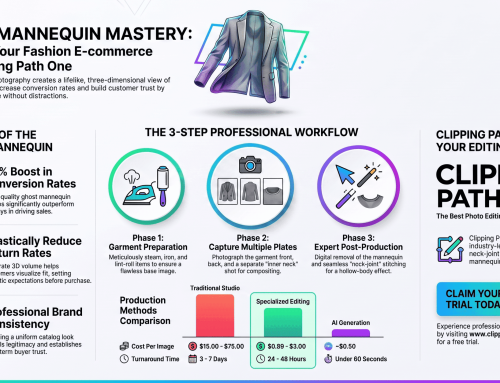
Mastering the invisible mannequin effect requires a precise, multi-step digital workflow. Understanding this process helps store owners appreciate the technical skill required for professional apparel retouching.
Step 1: Photographing the Garment on a Mannequin
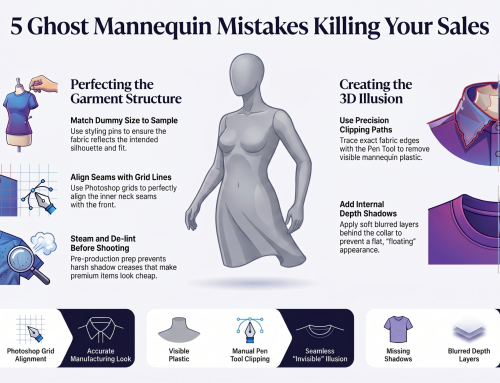
Shoot the apparel on a specialized mannequin with removable chest and neck pieces. Capture the front view of the garment clearly, ensuring the fabric is wrinkle-free and properly pinned.
Step 2: Capturing the Inner Neck Shot
Turn the garment inside out or photograph the inner label area separately on a mannequin with a lowered neckline. This provides the crucial inner neck and shoulder panels needed for the hollow effect.
Step 3: Digital Clipping and Masking
Import both images into editing software. Use pen tools to create precise clipping paths around the outer boundaries of the main apparel shot and the inner neck panel.
Step 4: Blending and Assembly
Merge the inner neck layer behind the front shell layer. Seamlessly align the collar edges so that the back neckline appears naturally visible through the front opening.
Step 5: Final Retouching and Shadow Addition
Clean up dust spots, smooth out harsh creases, and add realistic drop shadows beneath the garment to anchor it on a pristine white background.
Frequently Asked Questions (FAQs)
What is a ghost mannequin service?
A ghost mannequin service is a specialized photo editing technique that removes physical mannequins from apparel photos, creating a hollow, 3D effect that showcases clothing shape and fit.
How does ghost mannequin photography increase sales?
It increases sales by removing visual distractions, showing realistic garment contours, and giving online shoppers the confidence to purchase without trying the item on first.
Is outsourcing apparel photo editing cost-effective?
Yes, outsourcing saves significant time and labor costs compared to maintaining a full-time, in-house editing team, while ensuring superior quality and faster turnaround times.
Can ghost mannequin effects be applied to all types of clothing?
Yes, this technique works wonderfully for shirts, jackets, dresses, trousers, coats, and children’s wear, making any apparel item look professionally styled.
What software do professional editors use for invisible mannequin effects?
Professional editors primarily rely on Adobe Photoshop for precise pen-tool clipping paths, layer masking, and advanced blending techniques, often supported by specialized batch-processing tools.
Conclusion
Elevating your e-commerce store requires visuals that instantly capture attention and build absolute buyer trust. Traditional flat photos often fall short, while live model shoots can drain your operational budget. By utilizing a professional ghost mannequin service, you unlock the perfect balance of affordability, realism, and speed. Transforming your catalog with crisp, three-dimensional apparel images guarantees lower return rates and higher conversion growth for your brand.